
Why Foam Shows Up Before the Bottle Is Even Full
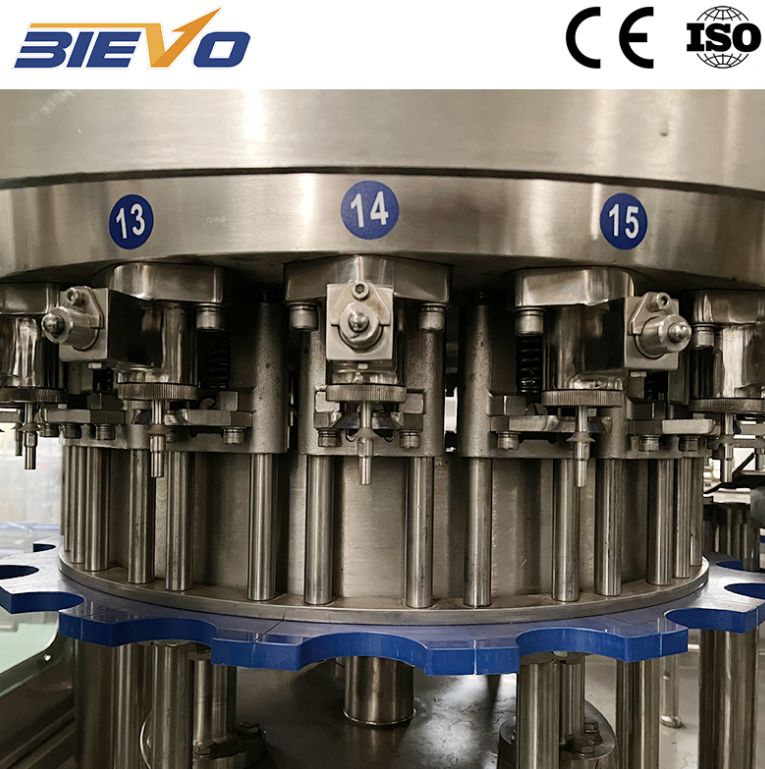
A carbonated drink filling machine has one job: move cold, pressurized liquid into a bottle without losing gas or making a mess. In practice, foam starts before the fill valve opens. Warm product, a sudden pressure drop, or air trapped in the line can seed bubbles that grow during the fill. Once bubbles reach the neck, the filler either has to slow down or accept short fills, drips, and rejected bottles.
Foam is not just cosmetic. It changes CO2 equilibrium in the package, throws off fill height, and pushes product into the capper, where sugar residue turns into sticky maintenance. The same residue can attract dust and microbes if cleaning is not tightened. That is why foam control belongs in mechanical design, not just the operator's checklist.
The Real Cost of a Small Leak on a High-Speed Line
Leakage gets less attention than foam because it often starts small. A cap with low torque, a nicked bottle finish, or a valve seat that does not close cleanly can lose a few drops per bottle. On a line running 12,000 bottles per hour, those drops become liters per shift. The bigger cost is downstream: wet cases, weak cartons, label damage, and returns that show up days later.
Leak detection at the filler is tricky because carbonated products are under pressure. A pinhole may seal with syrup during fill and open again in transport. Practical lines combine three checks: fill height by vision or gamma ray, closure torque by sampling, and package pressure decay on a timed sample. None catches everything, but together they narrow the window fast.
Temperature, Pressure, and Timing: The Three Levers That Tame Foam
Most foam problems trace back to three variables. Product temperature controls how much CO2 stays dissolved. Counter-pressure controls how gently the liquid meets the bottle. Valve timing controls flow profile at fill start and end. Get all three in range and the filler behaves like a quiet machine. Miss one and operators chase drips with a wrench.
A useful way to think about it is Henry's law: CO2 solubility rises with pressure and falls with temperature. Warm product is already trying to release gas. When the fill valve opens, the pressure drop gives that gas room to expand. A slow-opening valve ramp and a stable counter-pressure head reduce the shock. This is not a universal recipe, because syrup viscosity, bottle geometry, and carbonation level shift the window.
|
Variable |
Typical window |
What it controls |
Symptom when off target |
|
Product temperature |
2 to 6 C (35 to 43 F) |
CO2 retention and bubble stability |
Warm product flashes gas and foams |
|
Counter-pressure |
0.25 to 0.45 MPa, line dependent |
Gentle pressure equalization |
Pressure shock creates turbulence |
|
Valve opening ramp |
Often under 1.5 s |
Laminar flow at fill start |
Slamming open causes splashing |
|
Fill height |
About +/- 3 mm on PET lines |
Headspace and closure performance |
Overfill sends liquid to the capper |
|
Closure torque |
1.2 to 2.0 N m, closure dependent |
Seal integrity |
Low torque leaks, high torque distorts |
These numbers are starting points for a line audit, not a plug-and-play setting. A dairy-style filler and a carbonated soft drink filler do not share the same valve curve. The table is most useful when compared with actual trial data.
How a Carbonated Drink Filling Machine Handles the Fill Cycle
A counter-pressure filler works through a sequence: bottle lift, pressure equalization, fill, settle, release, and cap. The equalization step is where many leaks and foam events are born. If the bottle finish is damaged or the centering bell is worn, gas escapes and the fill becomes unstable. If the valve seal is stiff, the release step leaves a droplet on the bottle mouth, and that droplet becomes a sticky cap and leak path.
Good design puts attention on small parts: valve seats, O-rings, centering bells, and filler bowl level control. Stainless steel helps, but hygienic design matters more. EHEDG guidelines for hygienic design and ISO 22000 food safety management systems both push for cleanable surfaces, drainable geometry, and documented cleaning. Those details reduce the chance that a foam event turns into a microbial risk.
What a Practical Retrofit Looks Like on the Plant Floor
A retrofit project at a beverage plant in southern China showed how quickly one variable can move the whole line. The plant had switched to a warmer syrup batch during a summer push. Foam spikes appeared on a 500 mL PET line, and fill-height rejects climbed. Filler bowl temperature was near 9 C instead of the 4 C target because a chiller bypass valve had stuck open. Valve ramps were also too aggressive after a speed increase.
The fix was not a new filler. The crew restored the chiller loop, reset the counter-pressure setpoint, and retuned the opening ramp on the worst valves. A short trial with three torque settings found a cap window that held pressure without cracking the finish. Rejects dropped, but the plant still keeps a daily torque check because a warm afternoon can push the line back toward the edge.
Where the Limits Are and How to Judge a Supplier
No filling machine removes the need for line discipline. Highly carbonated products, odd bottle shapes, and high speeds narrow the stable window. A filler that runs well at 8,000 bottles per hour may need different valve curves at 18,000 bottles per hour. Plants should ask for trial data on their own bottle and product, not a catalog rating. A supplier that explains valve timing, pressure control, and closure interaction is usually a better partner than one quoting only price per valve.
BIEVO builds filling and packaging lines with attention to foam and leakage details: valve design, hygienic construction, and line integration. With more than 30 years of experience and a 7,000 m2 manufacturing base, BIEVO supports layout, installation, commissioning, and technical service for beverage producers across Asia, Africa, the Middle East, and South America.
Table of Contents
- Why Foam Shows Up Before the Bottle Is Even Full
- The Real Cost of a Small Leak on a High-Speed Line
- Temperature, Pressure, and Timing: The Three Levers That Tame Foam
- How a Carbonated Drink Filling Machine Handles the Fill Cycle
- What a Practical Retrofit Looks Like on the Plant Floor
- Where the Limits Are and How to Judge a Supplier