Pure water filling lines have become highly standardized, but the real competition lies in full-chain quality control. Unlike carbonated drinks that focus on pressure control or juice lines that focus on nutrient retention, pure water requires zero secondary pollution and stable water quality from the raw water inlet all the way to the finished pallet.
The first stage is the front-end water treatment. Raw water from municipal supplies or deep wells must go through multi-stage pretreatment. Sand filtration removes suspended solids and sediment, while activated carbon filtration adsorbs residual chlorine, odors, and organic impurities. Removing residual chlorine is critical because it will otherwise oxidize and destroy the RO membranes. A precision filter is placed right before the reverse osmosis (RO) system to trap any remaining fine particles. The RO system removes over 99% of heavy metals, dissolved salts, and microorganisms. The produced pure water then enters a sterile holding tank. To meet different food-grade standards, BIEVO’s system uses dual sterilization: a UV sterilizer and an ozone sterilizer. For high-end production, an EDI ultra-pure water upgrade is optional.
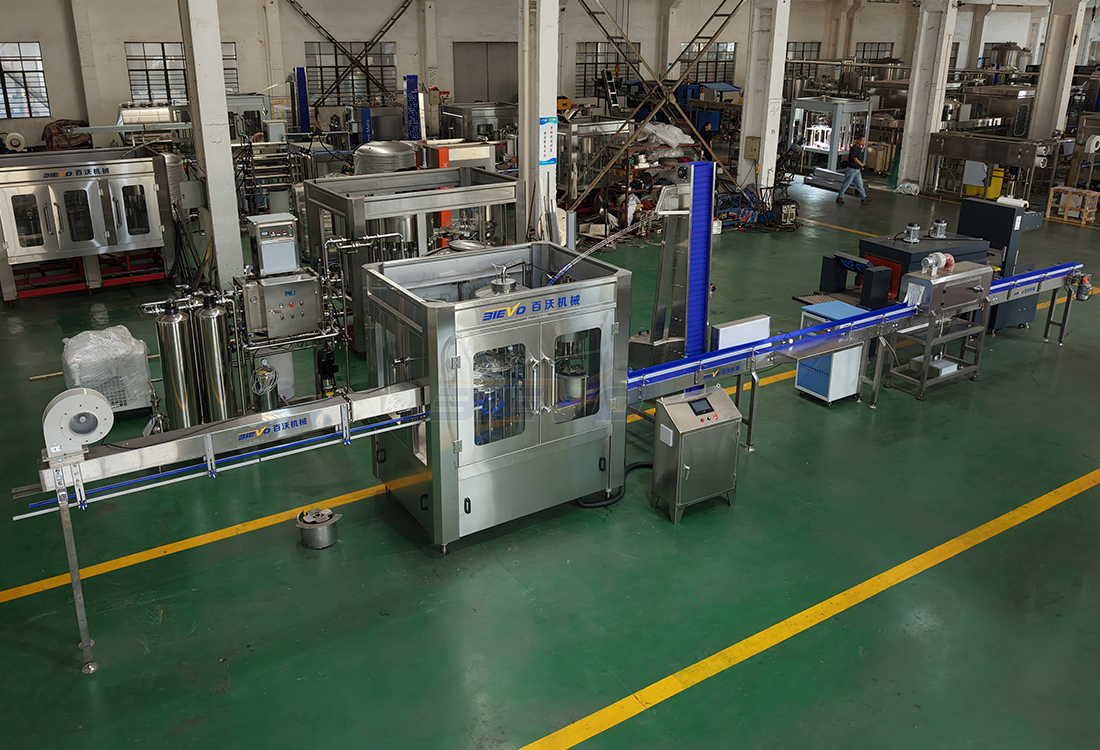
In the filling room, the core equipment is the 3-in-1 monoblock design, integrating washing, filling, and capping. PET bottles from the blow molding machine are transported to the CGZ series unit via an air conveyor. The line uses bottleneck suspension transmission, meaning the machine grips the rigid neck ring so the bottle body is never touched by mechanical parts, avoiding external contact contamination. Empty bottles are first rinsed with high-pressure pure water on the inner wall. They then enter the filling station, where gravity filling is applied. This method ensures a fast, stable fill and keeps the liquid level error strictly within 1.5%. For sealing, the magnetic torque capping head features stepless adjustable torque, providing a tight seal without damaging the cap surface. All product-contact parts are made of high-quality stainless steel with no sanitary dead corners, making CIP cleaning quick and thorough. The CGZ series covers a wide capacity range from 2,000 to 36,000 BPH, and handles bottle sizes from 330ml up to 10L.
After filling, a high-pressure blow dryer removes surface water stains, which ensures that the code sprayer and labels adhere properly. A code sprayer prints the batch number and production date, followed by labeling, shrink wrapping, or carton packing, and finally automatic palletizing. The entire line is governed by a PLC control system. It features automatic alarms for bottle shortage, cap shortage, and overload faults, allowing operators to find and eliminate issues immediately and ensuring a highly automated production flow with minimal manual intervention.
With the rising demand for customized bottle shapes and smaller package sizes, BIEVO’s pure water line adopts a modular design. This allows factories to quickly adapt to different bottle types or upgrade capacity without replacing the entire system. It can also be paired with a closed-loop water recycling system to reduce production energy consumption and wastewater discharge. For any factory, a stable and efficient pure water filling line is more than just production equipment—it is the core guarantee for product compliance and long-term market competitiveness.