
Star-Wheel Geometry and Infeed Conveyor Channel Calibrations
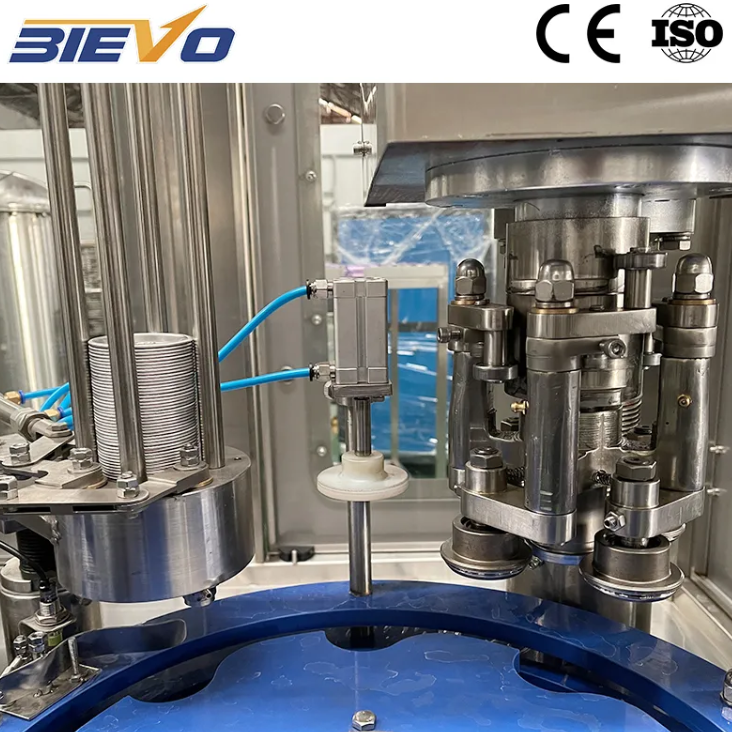
Switching container profiles on high-speed bottling lines requires precise mechanical realignment across the entire bottle handling path. Moving from standard cylindrical PET bottles to square or oval geometries alters how containers interact with infeed timing screws and rotary star-wheels. Adjusting an industrial juice filling machine starts with swapping out quick-change guide plates and pocketed star-wheels matched to the specific container diameter. According to mechanical guidelines from the Packaging Machinery Manufacturers Institute, improper pocket clearance exceeding 1.5 millimeters induces container tilting during high-speed transfer, leading to axial misalignments at the filler valve. Operators must set conveyor guide rail widths to allow a smooth two-millimeter side clearance along straightaways, preventing bottle pinching while maintaining strict vertical stability as containers move into the main rotary carousel.
Vertical Turret Elevation and Valve Seal Clearance Setting
Accommodating variations in bottle height demands accurate vertical adjustment of the main filler carousel and capping turret assembly. Modern rotary filling platforms utilize motorized central column lifting mechanisms driven by precision worm gear assemblies or synchronized jack screws. Adjusting the carousel height ensures that the neck finish meets the sealing rubber gasket with appropriate compressive force across all filling valves. Insufficient compression causes liquid leakage during press-filling cycles, whereas excessive downward force deforms lightweight PET bottle shoulders or damages delicate container necks. Technicians must verify that lift pedestals, bottle holders, or neck-handling grippers achieve full mechanical engagement without forcing the container body out of true vertical alignment.
- Measure container height from base to finish using digital calipers to establish the baseline central elevation offset.
- Actuate the central column elevator motor until the filling valve rubber seals depress by precisely 1.5 to 2.0 millimeters upon contact.
- Lock central elevation clamping collars securely to prevent creeping or vibration-induced height drift during high-speed production runs.
|
Bottle Geometry Type |
Changeover Mechanism |
Mechanical Downtime |
Alignment Sensitivity |
|
Standard Round PET (500ml) |
Standard Star-Wheels |
15 to 20 Minutes |
Moderate axial Tolerance |
|
Square Heavy-Wall PET (1000ml) |
Profiled Pocket Inserts |
30 to 45 Minutes |
High rotational alignment |
|
Oval Glass Bottle (330ml) |
Neck-Gripping Clamps |
40 to 60 Minutes |
Critical neck-finish centered |
|
Lightweight Contoured Bottle |
Vacuum Infeed Star-Wheels |
25 to 35 Minutes |
High side-pressure limit |
Liquid Dose Volume Calibration Across Varying Geometries
Container volume adjustments require matching physical dosing mechanisms to product viscosity, liquid temperature, and target fill line marks. Hot fill or ambient beverage lines rely on gravity overflow valves, magnetic flow meters, or positive displacement piston dosing cylinders. When changing from small single-serve containers to large multi-serve bottles, technicians must recalibrate flow meter pulse counts or physically adjust vent tube lengths. Vent tube positioning determines the final fill height in gravity overflow systems, as liquid stops flowing once product blocks the air return path. Flow-meter-based systems require updating recipe parameters in the human-machine interface panel, where volume formulas automatically scale liquid valve opening durations to match target milliliter ratings accurately.
Plant Case Study on Square Bottle Corner Deformations
During a format conversion project at a fruit nectar bottling facility in Central America, operators encountered severe line stoppages when introducing a new 1.0-liter square PET bottle. The original line processed round 500-milliliter containers under continuous operating conditions. During high-speed transfer, the square container corners caught on standard curved star-wheel guides, causing container rotation, scuffing, and valve jamming. The engineering team replaced standard star-wheels with custom-profiled inserts featuring integrated nylon rollers along the guide channels. Additionally, infeed screw timing was re-indexed to match corner orientations smoothly. These modifications eliminated container jamming, stabilized container positioning under filling heads, and allowed seamless changeovers between round and square container formats without loss of throughput.
Capping Head Pressure and Thread Engagement Tuning
Changing bottle formats often involves transitioning between different closure dimensions, such as moving from 28-millimeter short-thread caps to 38-millimeter wide-mouth caps. Adjusting capping turrets involves replacing capper chucks, adjusting magnetic clutch torque values, and resetting cap chute feed rails. Magnetic capping heads require precise torque settings to ensure leak-free sealing without stripping threads or galling plastic closures. Technicians must check application torque using calibrated torque meters, verifying that removal torque remains within industry standards. Rail spacing along cap sorter chutes must also be calibrated to prevent cap shingling, jamming, or orientation flips before closures enter the pick-and-place capping zone.
System Integration and Multi-Format Operational Consistency
Achieving rapid, repeatable line adjustments across diverse bottle shapes requires a unified approach combining mechanical design, electronic control recipes, and standardized operator training. Disconnects between blow molding, filling, labeling, and case packing equipment increase total changeover times, create bottlenecks, and introduce operational errors. Preserving digital parameter recipes within main PLC architectures allows operators to recall height, speed, and volumetric settings with minimal manual fine-tuning. Machinery manufacturing and line integration from BIEVO merge flexible mechanical design, robust quality control standards, and global technical field support, enabling beverage producers to maintain high production consistency across varied container formats.
Table of Contents
- Star-Wheel Geometry and Infeed Conveyor Channel Calibrations
- Vertical Turret Elevation and Valve Seal Clearance Setting
- Liquid Dose Volume Calibration Across Varying Geometries
- Plant Case Study on Square Bottle Corner Deformations
- Capping Head Pressure and Thread Engagement Tuning
- System Integration and Multi-Format Operational Consistency