
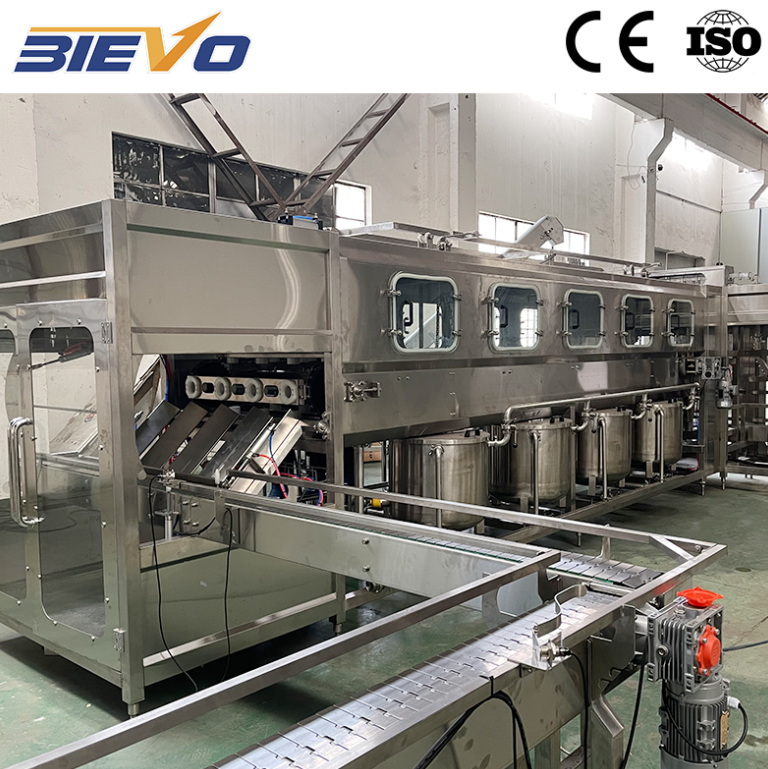
Rigorous Sanitation Regimens and Water Quality Management
Extending operational longevity on liquid packaging lines requires strict control over liquid chemistry and microbial scaling. Mineral buildup inside filling valves, flow sensors, and liquid distribution manifolds restricts orifice clearance, leading to uneven pressure drops across rotary carousels. Operating a high-capacity water filling machine without adequate water filtration promotes calcium carbonate precipitation, which scores polished stainless steel valve bodies during rapid mechanical cycling. Modern bottling facilities utilize multi-stage reverse osmosis systems alongside regular chemical sanitization routines. Technical guidelines from the International Bottled Water Association highlight that maintaining rinse water conductivity below 10 microsiemens per centimeter prevents scale buildup and stops bio-film accumulation. Implementing scheduled ozonated water back-flushes clears internal fluid passages, keeping internal surfaces smooth and protecting delicate seal faces from abrasive particulate wear. Periodic flushing with mild descaling fluids further mitigates micro-calcification inside complex filling nozzles.
Precise Lubrication Schedules and Grease Specification Standards
Moving mechanical assemblies across high-speed rotary packaging equipment require disciplined lubrication routines using NSF H1 food-grade lubricants. Bearings supporting main central columns, drive gears, bottle lift pedestals, and capper turrets operate under continuous rotational strain and moisture exposure. Applying excessive grease invites airborne dust accumulation, creating an abrasive paste that degrades roller bearings and shaft seals. Conversely, under-lubrication causes metal-to-metal contact, leading to fretting corrosion and thermal expansion binding. Technicians should follow manufacturer grease quantity metrics rather than relying on visual inspection alone. Automatic grease dispensing units attached to primary drive shafts supply controlled lubricant micro-doses at set operating intervals, reducing manual errors and maintaining low friction coefficients across drive components. Establishing customized grease replenishment intervals for each bearing housing protects rotating gearboxes against early surface pitting.
|
Maintenance Task |
Recommended Interval |
Key Technical Metric |
Risk of Neglect |
|
Valve Seal Replacement |
Every 2000 Operating Hours |
Shore A Hardness within 65 to 70 |
Micro-leaks and volume variance |
|
Central Column Lubrication |
Weekly or Auto-Dose |
NSF H1 Food-Grade Grease Volume |
Shaft scoring and drive binding |
|
Air Filter Element Swap |
Monthly |
Differential Pressure under 0.02 MPa |
Pneumatic valve actuation lag |
|
Infeed Star-Wheel Alignment |
Bi-Weekly |
Axial Offset below 0.5 mm |
Container scuffing and line jams |
Pneumatic System Air Quality and Moisture Control
Pneumatic actuators drive bottle lift cylinders, capping chucks, and liquid cut-off valves throughout high-speed bottling operations. Wet or contaminated compressed air introduces liquid water, pipe scale, and compressor oil into pneumatic solenoid valves, causing seal swelling and delayed valve actuation. According to ISO 8573-1 compressed air quality standards, bottling plants should maintain Class 1 particle, water, and oil ratings for direct contact zones. Installing refrigerated air dryers alongside three-stage coalescing filters removes entrained moisture and sub-micron oil aerosols before compressed air reaches main manifold distribution blocks. Draining filter bowls daily and replacing filtration cartridges on strict operating hour schedules prevents pressure drops, maintaining crisp cylinder movements during high-speed production runs. Installing differential pressure indicators on air treatment banks provides immediate visual feedback when filter elements become clogged.
Field Case Study on Bearing Failure in Southeast Asia
During a technical support audit at a purified water bottling plant in Southeast Asia, production records showed repeated main drive motor trips and severe central column vibration on a forty-head rotary filling machine. Local technicians had been applying high-viscosity industrial grease intended for heavy mining gear onto the main rotary carousel bearings, assuming thicker grease provided better protection in hot environments. The thick lubricant created high viscous drag, forcing drive motor current draws above thermal trip thresholds. Engineers purged the contaminated bearing housings, flushed the race tracks with solvent, and refilled the assembly with specified synthetic food-grade grease. This intervention immediately lowered motor current draw by eighteen percent, eliminated carousel vibration, and restored smooth mechanical rotation across all production shifts.
Optical Sensor Calibration and Fastener Torque Maintenance
Electronic bottle detection sensors, fiber-optic photo-eyes, and proximity switches coordinate container timing throughout infeed screws, star-wheels, and capping stations. Water spray, condensation, and vibration obscure sensor lenses over time, causing phantom bottle readings or missed container triggers. Wiping optical lenses daily with isopropyl alcohol wipes and verifying sensing distances prevents line stoppages. Simultaneously, continuous vibration from high-speed rotation causes mechanical fasteners to loosen on conveyor guide rails, valve clamps, and star-wheel hubs. Maintenance personnel should check critical bolt torque values using calibrated torque wrenches during planned weekly shutdowns, applying medium-strength thread-locking compounds to fasteners exposed to operational vibration. Conducting systematic torque checks across secondary clamping assemblies prevents minor alignment shifts before they disrupt container handoff sequences.
System Maintenance Protocols and Equipment Engineering Continuity
Preserving mechanical accuracy and operational stability over years of continuous service requires combining daily operator checklists, preventive component swaps, and factory-certified technical audits. Siloed maintenance practices lead to uncoordinated component replacements, increasing long-term operational costs and equipment wear. Utilizing digital maintenance logs allows plant managers to track seal wear patterns, monitor motor power consumption, and schedule major component overhauls before catastrophic mechanical failures occur. Equipment manufacturing and line support services from BIEVO combine heavy-duty stainless steel structural design, precision machining standards, and global technical field support, providing beverage producers with a durable foundation for long-term production reliability.
Table of Contents
- Rigorous Sanitation Regimens and Water Quality Management
- Precise Lubrication Schedules and Grease Specification Standards
- Pneumatic System Air Quality and Moisture Control
- Field Case Study on Bearing Failure in Southeast Asia
- Optical Sensor Calibration and Fastener Torque Maintenance
- System Maintenance Protocols and Equipment Engineering Continuity