
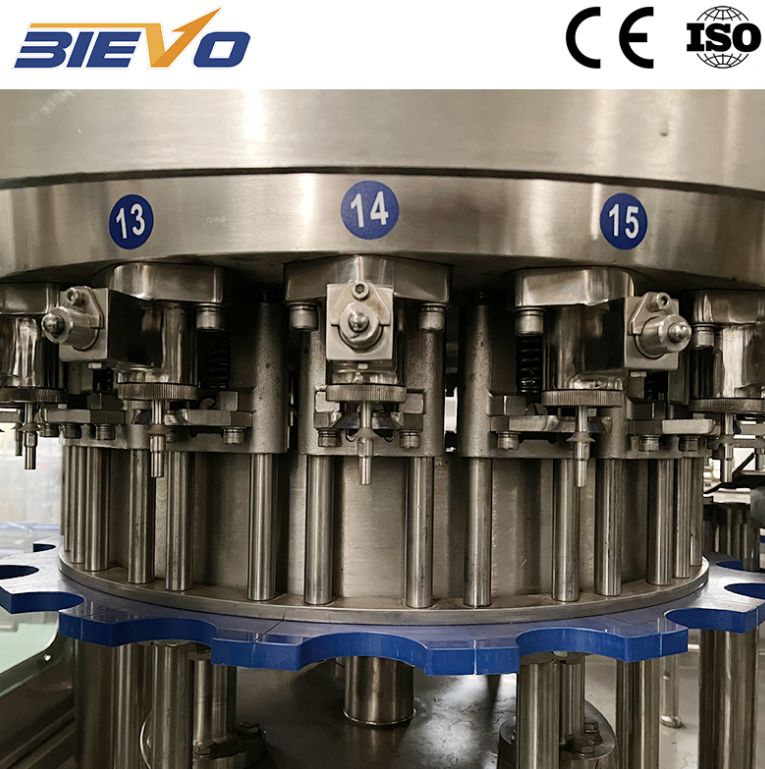
Pressure Is the Hidden Variable Behind Consistent Carbonation
For a carbonated drink filling machine, pressure is not a background utility. It holds CO2 in solution long enough for product to reach the bottle or can without turning into foam. Clean valves and precise cap torque cannot fix uneven fill heights if bowl pressure wanders. The symptom often looks like a valve or temperature issue. In many line audits, the root cause sits in the pressure loop: CO2 supply, bowl head pressure, product temperature, and filler response to demand.
Carbonation is a balance, not a single number. Henry's law describes the core behavior: dissolved gas concentration rises with partial pressure and falls as temperature climbs. Standard methods from the American Society of Brewing Chemists treat dissolved CO2 as a function of pressure, temperature, and equilibrium time. A gauge reading alone cannot prove the product is on spec. Product temperature and actual equilibrium inside the bowl tell the rest.
What Happens When Head Pressure Drifts
In a counter-pressure filler, product flows after the bottle headspace is pressurized close to bowl level. If bowl pressure drops, CO2 can break out before the valve closes. If pressure climbs, fill or snift behavior can shift. Both directions create variation, and the symptom appears downstream: foam in the neck, uneven fill height, or a wet cap. Fast oscillation is usually worse than a slow drift. A sticky regulator or a supply line that is too small can affect thousands of bottles before a lab sample catches it.
A Real Line Audit: Foam Was Not the Root Cause
A retrofit at a beverage plant in southern China offered a useful lesson. The line filled 500 mL PET bottles with a carbonated soft drink. Foam at the filler exit and fill heights drifting by several millimeters led to a valve rebuild plan. Before the rebuild, an audit logged bowl pressure, product temperature, and CO2 supply pressure at one-minute intervals. The valves were not the main issue. The CO2 regulator was creeping upward after long runs, and bowl pressure oscillated when filler speed changed. A new regulator, a larger supply line, and a re-tuned pressure loop reduced foam enough that the rebuild was deferred. The case does not prove valves never fail. It shows why pressure data should come before parts replacement.
Data That Makes the Case for Tight Pressure Windows
Pressure control is not about a perfect gauge number. It is about keeping the loop inside a window that matches product, package, and line speed. The table shows typical directions seen in CSD filling audits. It is a diagnostic guide, not a guarantee for every recipe.
|
Pressure condition |
Dissolved CO2 trend |
Fill height behavior |
Foam and scrap risk |
|
Stable within a narrow band |
Holds near target, such as 3.0 vol CO2 at a set temperature |
Even fills across the run |
Low and predictable |
|
Slow upward drift |
CO2 creeps above target |
Slight overfill or inconsistent snift |
Rises near the end of long runs |
|
Slow downward drift |
CO2 falls below target |
Underfill risk and flat product |
Rises when the line speeds up |
|
Fast oscillation |
CO2 swings around target |
Uneven fills bottle to bottle |
High, especially at high filler speed |
The window is product specific. A lightly carbonated fruit drink may run lower than a cola, and a warm product needs a different equilibrium pressure than a cold one. A setpoint copied from another line can cause trouble. The setpoint has to tie to the recipe, temperature chart, and package format.
Practical Checks and Hygiene Interactions
Pressure loops also touch cleaning and changeover. A bowl that cannot hold pressure cleanly may pull air through a seal or leave a hard-to-rinse pocket. During CIP, pressure checks can reveal a worn seal before it becomes a quality issue. During changeover, fast pressure recovery shortens the gap between the last bottle of one run and the first acceptable bottle of the next. Pressure control cannot fix a dirty valve, a worn seal, or poor temperature control. It removes one major source of variation.
Before blaming the filler, check the basics: 1. Confirm the pressure gauge is calibrated and sees the bowl, not a dead leg. 2. Log pressure at production speed, not only at idle. 3. Compare CO2 supply pressure with bowl pressure during peak demand. 4. Verify product temperature against the recipe, not just the cooler display. 5. Inspect regulators and supply lines for creep, restriction, or moisture. These checks often separate a pressure problem from a mechanical one.
For beverage producers planning a carbonated drink filling machine upgrade or a pressure loop review, BIEVO brings more than 30 years of filling and packaging machinery experience, a 7,000 m² manufacturing base, and 50+ patented technologies to the conversation. The useful starting point is a clear pressure window, a temperature chart, and a line speed profile the filler can actually hold.