
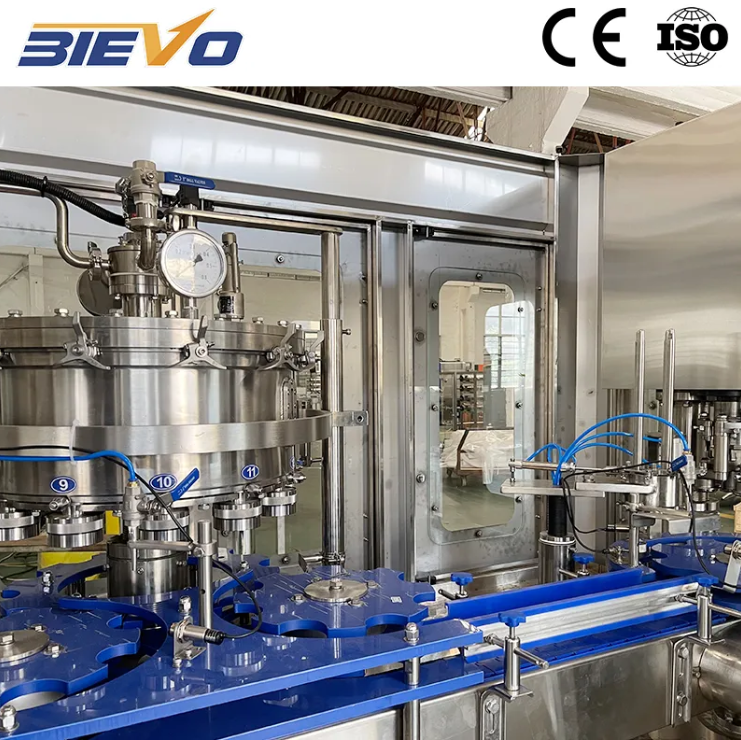
Core Automation Architecture of Full Automatic Beer Filling Machine
A full automatic beer filling machine integrates bottle rinsing, counter-pressure filling, capping and inline inspection within a single linked frame, removing manual transfer and positioning steps that create bottlenecks in semi-automatic brewery setups. Every mechanical movement links to a central PLC control module that synchronizes star wheel rotation, filling valve actuation and conveyor speed without human intervention during continuous production cycles.
Modular segmented design splits the system into wash manifolds, carbonation balance tanks, servo filling valve clusters and vision check stations. Each segment carries independent sensor feedback loops to flag pressure drift, foam overflow or misaligned glass containers in real time. Unlike standalone semi-automatic filling units that require separate operator stations between processes, this unified layout eliminates idle gaps that cut effective hourly output.
Critical sensor groups track dissolved oxygen levels, internal tank CO2 concentration and filling volume deviation, feeding live data to touchscreen dashboards for production supervisors to adjust parameters without halting the entire line.
Quantifiable Productivity Gains Against Semi-Automatic Brewing Equipment
Labor reliance and inconsistent cycle timing remain the biggest drag on output for breweries using split semi-automatic filling hardware. The unified operation logic built into a full automatic beer filling machine delivers measurable throughput improvements across daily, weekly and annual production windows.
1.Continuous 24-hour operation capability removes mandatory shift change pauses that eat up 12 to 18 production hours per week on manual-dependent lines
2.Synchronized multi-station motion cuts bottle handling interval time by nearly 60 percent compared to separate manual loading and unloading workflows
3.Automated inline defect rejection eliminates 30 to 50 minutes of post-production sorting work at the end of each shift
A performance comparison table quantifies gaps between semi-automatic and fully integrated filling configurations using real industry operational benchmarks:
|
Production Metric |
Semi-Automatic Beer Filling Setup |
Full Automatic Beer Filling Machine |
Measurable Operational Difference |
|
Minimum On-Site Operators |
6–8 staff per line |
1–2 patrol inspectors |
70–85% reduction in direct labor headcount |
|
Average Hourly Output (500ml Glass Bottles) |
3,200–4,500 bottles |
7,800–11,200 bottles |
140–150% higher effective throughput |
|
Daily Unplanned Downtime |
90–130 minutes |
15–30 minutes |
75% drop in idle production time |
|
Monthly Beer Product Waste |
2.1–2.8% of total batch volume |
0.4–0.7% of total batch volume |
70–80% cut in raw liquid loss |
|
Weekly Line Calibration Hours |
8–10 hours manual adjustment |
1.5–2 hours auto-calibration + spot check |
80% less scheduled maintenance labor |
Data published in the 2025 Global Beverage Packaging Machinery Industry Report confirms breweries operating fully automated filling lines record average annual output growth of 38 percent within 12 months after equipment installation, driven by both higher running hours and lower material waste ratios.
Cost Reduction Streams That Shorten Equipment ROI Cycles
Return on investment calculations for packaging equipment rarely focus on hidden recurring expenses eliminated by a full automatic beer filling machine. Three consistent cost categories deliver compound savings that compress payback windows significantly for mid and large-scale brewing facilities.
Labor cost reduction forms the largest recurring saving stream. Regional brewery payroll data shows food-grade production labor costs rise 9 to 11 percent each year, so cutting six full-time line operators removes six-figure annual wage and benefit overhead. Second, reduced beer waste lowers monthly raw material expenditure, as submerged dual-speed filling and vacuum anti-drip valves limit foam spillage and overfilling common in manually adjusted semi-automatic valves. Third, automated vision detection cuts secondary quality control labor and customer complaint losses caused by uneven fill levels or loose caps.
A medium-sized craft brewery upgrade project in eastern Zhejiang demonstrates this financial impact clearly. The facility replaced a multi-piece semi-automatic filling setup with a unified full automatic beer filling machine in early 2024. Prior to the upgrade, monthly combined spending on line labor, discarded beer batches and manual quality sorting reached $12,700. Post-installation monthly recurring costs dropped to $3,900, generating monthly operational savings of $8,800. The incremental equipment investment recovered within 19 months of consistent full-capacity production runs.
Intelligent Control Systems That Stabilize Long-Term Batch Consistency
Unstable carbonation, elevated dissolved oxygen and inconsistent fill volume create uneven beer flavor profiles that damage brand loyalty, issues frequently triggered by human adjustment errors on semi-automatic filling hardware. The intelligent control architecture fitted on a full automatic beer filling machine locks standardized process parameters to eliminate variable manual tuning. Built-in pressure transducers auto-adjust counter-pressure inside filling chambers based on real-time beer temperature readings, maintaining target CO2 retention without operator tweaks. Online weight sensors verify each filled bottle’s liquid mass and trigger automatic valve flow correction if deviation crosses the ±0.3% tolerance threshold outlined in international food measurement standards. Stored recipe profiles store unique filling pressure, speed and CO2 levels for lager, ale and fruit-infused beer variants, enabling one-click format switching without lengthy manual recalibration between product batches.
Digital log storage archives every fill cycle’s operational data for compliance audits, removing the need for handwritten production records that carry transcription error risks during regulatory inspections.
Practical Operational Limitations to Avoid Overestimated ROI
No automated filling platform delivers unlimited financial gains, and unaccounted constraints can skew ROI projections during pre-purchase planning. Recognizing these inherent limits prevents unrealistic production and profit forecasting for brewery management teams.
Full automatic beer filling machine layouts require larger dedicated floor space than compact semi-automatic split units, which adds incremental facility rental or construction costs for small breweries with limited workshop square footage. Extended continuous production runs create higher annual power consumption compared to lower-speed semi-automatic lines, a minor recurring cost that must factor into long-term return calculations. Modular retooling for drastically different bottle shapes requires scheduled shutdown time, slowing short-term output during rapid multi-SKU production cycles. Facilities operating below 40 percent of the machine’s rated hourly throughput will extend payback timelines, as fixed equipment overhead spreads across fewer finished product units.
These constraints do not negate overall efficiency benefits, but they demand accurate capacity forecasting before finalizing equipment procurement budgets.
Modular Hardware Design Supporting Scalable Brewery Expansion
Scalability stands as an often-overlooked financial advantage of full automatic beer filling machine platforms, supporting gradual production expansion without full line replacement as brewery order volumes grow year over year. All core functional modules including bottle washing manifolds, filling valve banks and capping assemblies feature standardized connection interfaces for later capacity expansion upgrades.
1.Additional filling valve clusters can mount onto the main frame to lift hourly throughput without replacing the central PLC and conveyor base
2.Optional inline pasteurization or cold sterilization modules integrate into the existing production flow to launch shelf-stable beer product lines
3.Automated end-of-line carton packing and palletizing attachments bolt onto the downstream conveyor to eliminate separate manual packaging stations
This modular interchangeable hardware structure avoids the total equipment write-off costs common with rigid semi-automatic filling systems that cannot scale beyond their original fixed capacity limits. Equipment built by BIEVO adopts uniform modular mechanical frameworks across all beverage filling configurations, drawing on its 7,000 square meter precision manufacturing plant and over 50 proprietary component patents to streamline expansion upgrades and lower long-term operational overhead for brewing operators.
Table of Contents
- Core Automation Architecture of Full Automatic Beer Filling Machine
- Quantifiable Productivity Gains Against Semi-Automatic Brewing Equipment
- Cost Reduction Streams That Shorten Equipment ROI Cycles
- Intelligent Control Systems That Stabilize Long-Term Batch Consistency
- Practical Operational Limitations to Avoid Overestimated ROI
- Modular Hardware Design Supporting Scalable Brewery Expansion