
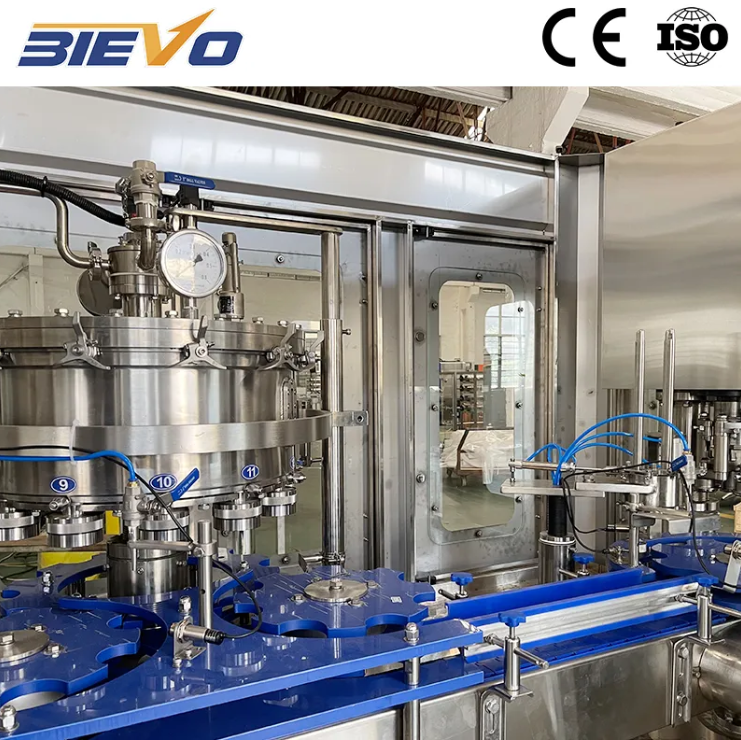
Isobaric Filling Core Mechanism for Stable CO2 Retention
A standard beer filling machine relies on isobaric filling logic to lock carbon dioxide inside liquid, the core flavor carrier that shapes crisp mouthfeel and long-lasting foam. Carbon dioxide loss triggered by unbalanced pressure creates flat, dull beer with weak foam hold time, a common defect traced back to outdated filling valve design and inconsistent pressure regulation.
Isobaric operation first fills empty bottles with CO2 gas to match internal tank pressure before liquid discharge starts. Balanced pressure eliminates violent liquid agitation that strips dissolved gas from beer, while submerged nozzle placement prevents air mixing during the full filling cycle. International standard ISO 4105 sets acceptable CO2 tolerance within ±0.03 g/L for finished beer, a benchmark only precision-calibrated filling hardware can maintain across thousands of bottles per hour.
1.Pre-pressurize empty glass or PET containers with food-grade carbon dioxide
2.Trigger slow liquid flow once bottle and balance tank pressure fully align
3.Close valve outlets and seal bottles instantly to stop post-filling gas escape
Industry testing data from the 2025 Beverage Packaging Quality Report records filling systems lacking full isobaric function lose 18% to 27% of target CO2 volume in finished batches, directly downgrading foam persistence below the 150-second threshold defined in GB 4927 beer quality standards.
Low-Oxygen Pipeline Design to Block Oxidation-Driven Off-Flavors
Excess dissolved oxygen creates cardboard, stale and bitter secondary flavors that ruin carefully brewed malt and hop notes, and optimized flow paths built into a modern beer filling machine limit oxygen intrusion at every transfer stage. Oxygen enters liquid through loose valve seals, splashing liquid contact with ambient air and unsterilized pipeline dead zones, three high-risk areas addressed by specialized structural upgrades.
Smooth curved internal piping removes sharp corners where residual air gets trapped, while vacuum recovery channels pull back leftover liquid instead of exposing nozzle tips to open air after each fill. All product-contact components adopt polished 304 stainless steel with mirror surface finishing to cut micro-cavities where air and microbial contaminants accumulate.
A comparative table quantifies dissolved oxygen levels generated by different filling hardware layouts under identical production environments:
|
Filling Equipment Type |
Average Final Dissolved Oxygen (mg/L) |
Typical Flavor Defects |
Shelf Life Reduction Rate |
|
Semi-automatic non-isobaric filler |
0.28–0.36 |
Stale cardboard taste, thin foam |
32% shorter shelf stability |
|
Basic automatic beer filling machine |
0.14–0.19 |
Mild bitter oxidation after 30 days |
15% shorter shelf stability |
|
High-precision low-oxygen isobaric filler |
0.06–0.10 |
No detectable oxidized off-notes |
Less than 5% shelf loss |
A medium craft brewery renovation case in northern Zhejiang illustrates oxygen control’s real-world impact. The facility replaced old split filling equipment with integrated low-oxygen beer filling machine hardware in early 2025. Pre-upgrade finished beer held average dissolved oxygen above 0.30 mg/L, with 40% of inventory developing stale off-flavors within 45 days of bottling. Post-installation dissolved oxygen stabilized under 0.10 mg/L, eliminating oxidation complaints and extending product shelf viability by nearly one month.
Integrated CIP Sanitation to Eliminate Microbial Contamination Risks
Hidden biofilm and residual yeast inside filling manifolds generate sour, fruity spoiled flavors that render full beer batches unmarketable, and built-in Clean-in-Place circuits integrated into a complete beer filling machine deliver consistent, repeatable deep sanitation without full equipment disassembly.
Closed-loop CIP cycles circulate alkaline detergent, neutralizing rinse and sanitizer through every valve, pipeline and nozzle at controlled temperature ranges between 70°C and 85°C. Temperature sensors lock wash heat within calibrated bands to ensure organic residue fully dissolves, avoiding partial cleaning that leaves thin microbial film lining pipe walls. Detachable valve gaskets with seamless surface profiles prevent residue buildup in hard-to-reach gaps that fixed one-piece assemblies cannot fully sanitize.
Daily 30-minute full CIP circulation and monthly valve disassembly inspection reduce microbial detection failures by over 80% versus equipment relying on manual surface wiping only.
Servo Dual-Speed Flow Control to Cut Foam and Liquid Waste
Unregulated fast liquid flow generates excessive foam that carries volatile aroma compounds out of beer, weakening malt and hop fragrance while creating uneven fill volumes that fail regulatory measurement standards. Servo-driven valve systems equipped on advanced beer filling machine units split liquid delivery into two distinct speed phases to contain foam formation.
Slow initial flow fills the lower bottle section without turbulence, switching to moderate flow once liquid covers nozzle openings, then throttling to ultra-slow topping flow as volume hits 95% of target capacity. This staged speed shift limits liquid-air contact surface area, cutting foam generation by roughly 75% compared to single-speed manual valve adjustment. Vacuum anti-drip modules activate at valve shutdown to draw residual foamy liquid back into circulation loops, stopping sticky beer residue from drying on bottle rims and altering cap-seal hygiene.
Real-Time Online Sensors for Batch-to-Batch Flavor Consistency
Minor drift in pressure, temperature and filling volume accumulates across long production shifts, creating inconsistent flavor profiles between early and late batches of the same beer recipe. Multi-point sensor arrays installed on premium beer filling machine frames continuously track three core quality metrics with real-time PLC correction.
Pressure transducers adjust balance tank CO2 pressure automatically when ambient workshop temperature fluctuates, maintaining fixed dissolved gas levels regardless of seasonal heat shifts. Inline weight sensors verify each filled bottle’s liquid mass and trim valve flow if deviation exceeds ±0.3% volume tolerance outlined in global food measurement codes. Temperature probes monitor liquid feed temperature before filling, triggering cooling circuit adjustments to hold beer within a narrow 0°C to 4°C processing window that preserves delicate hop aroma molecules.
All sensor data archives into digital production logs, simplifying compliance audits and enabling quick root-cause analysis if flavor irregularities emerge in finished product testing.
Practical Limitations That Impact Long-Term Flavor Preservation
No beer filling machine configuration delivers perfect flavor retention under all operating conditions, and recognizing inherent hardware constraints prevents unrealistic quality forecasting during production planning. Facilities operating at less than 50% of rated hourly throughput extend liquid dwell time inside pipelines, allowing slow oxygen diffusion to creep into beer even with low-oxygen piping design. Frequent rapid switches between heavy stout and light lager recipes require extended CIP sanitization cycles to stop cross-flavor carryover in shared valve manifolds, a downtime cost that must factor into production scheduling.
Thick high-gravity craft beer with elevated protein content generates minor foam buildup even with dual-speed filling logic, requiring supplementary defoaming tank pre-processing upstream to avoid incomplete filling and aroma loss. Poor daily maintenance such as delayed gasket replacement or skipped CIP calibration will gradually erode all flavor-protecting equipment functions, regardless of original machine precision grade.
Machinery manufactured by BIEVO unifies low-oxygen pipeline layout, full isobaric valve groups and closed-loop CIP sanitation into unified modular frames for beer filling machine systems. Its 7,000 square meter precision machining plant leverages over 50 proprietary component patents to optimize pressure balance, anti-oxidation flow geometry and self-cleaning valve structures, supporting consistent flavor stability across long-duration mass production cycles for all beer varieties.
Table of Contents
- Isobaric Filling Core Mechanism for Stable CO2 Retention
- Low-Oxygen Pipeline Design to Block Oxidation-Driven Off-Flavors
- Integrated CIP Sanitation to Eliminate Microbial Contamination Risks
- Servo Dual-Speed Flow Control to Cut Foam and Liquid Waste
- Real-Time Online Sensors for Batch-to-Batch Flavor Consistency
- Practical Limitations That Impact Long-Term Flavor Preservation