
Understanding Why Foam Forms in the First Place
Foam is not the enemy in a beer glass. It carries aroma compounds and contributes to mouthfeel. But inside a beer filling machine running at high speed, excessive foam becomes a production nightmare. It leads to inconsistent fill levels, product loss on the brewery floor, and slower line speeds because operators must dial back throughput just to keep things under control. The root cause is always the same: carbon dioxide coming out of solution too aggressively. Beer holds dissolved CO2 under pressure after fermentation or forced carbonation. When that pressure drops suddenly during filling, the gas rushes to escape, dragging liquid with it into a frothy mess. Temperature plays an equally critical role. Warm beer simply will not hold its carbonation, no matter how carefully the filling valves operate. Understanding this interplay between pressure, temperature, and turbulence is where any serious foam control strategy begins.
The Critical Role of Counter Pressure Filling
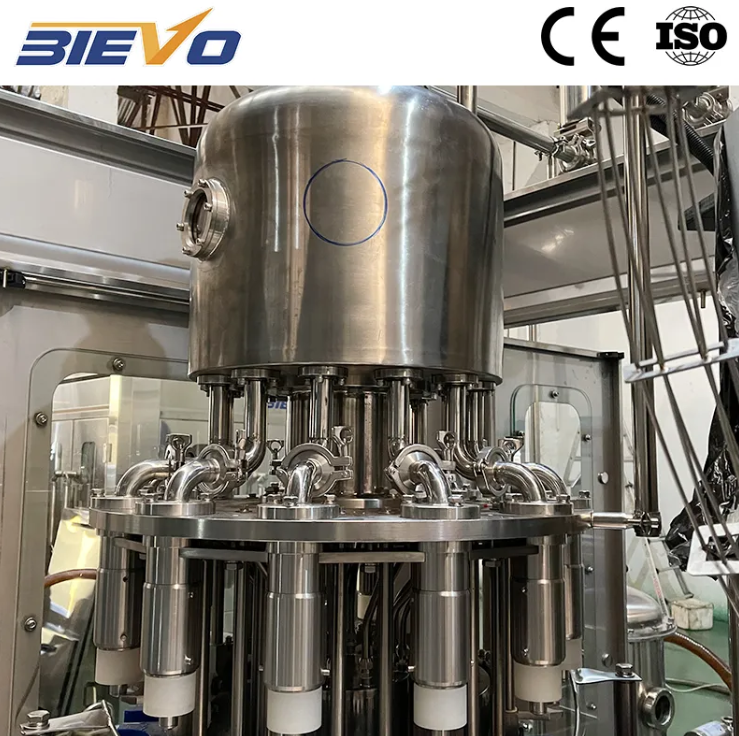
The most effective defense against unwanted foam starts with the filling technology itself. Counter pressure filling, sometimes called isobarometric filling, has become the standard for high speed beer lines for good reason. The principle is straightforward: pressurize the bottle or can with an inert gas, usually CO2 or nitrogen, to match the pressure inside the beer storage tank before any liquid flows. This eliminates the explosive pressure differential that triggers massive breakout. Once the vessel is pressurized, the filling valve opens and beer flows gently down the container wall. A well tuned counter pressure system then vents the displaced gas back to a return channel rather than letting it bubble up through the incoming beer. Snifters on the valve body perform a final brief pressure release after filling, creating just enough foam to purge oxygen from the headspace before the crowner or seamer locks the closure in place. When this sequence is timed correctly, dissolved oxygen pickup stays low and foam stays where it belongs, inside the closed container rather than spilling onto the conveyor.
Why Temperature Control Makes or Breaks Your Fill
Even the most sophisticated beer filling machine cannot compensate for poor thermal management upstream. Breweries learn this lesson the hard way. Beer arriving at the filler at six degrees Celsius behaves dramatically differently from beer arriving at two degrees. The colder the product, the more CO2 stays dissolved and the less foam nucleates during pressure transitions. A temperature drop of just a few degrees can mean the difference between hitting target speeds and slowing the entire packaging hall. This is why large scale operations invest heavily in glycol jacketed buffer tanks and insulated product lines between the bright beer tank and the filler. The target is simple but demanding: keep the beer consistently below three degrees Celsius all the way to the filling valve. Any warm spot in the piping creates nucleation sites where bubbles form prematurely. A brewery in Southeast Asia once traced a persistent foaming problem to a section of product pipe running too close to a pasteurizer steam line. Relocating that pipe eliminated the issue entirely without any changes to the filler settings. That kind of attention to the thermal environment separates efficient packaging lines from ones that constantly struggle.
How Line Speed and Turbulence Feed the Foam Problem
Speed amplifies every small imperfection in the filling process. When a filler accelerates from mid range throughput to maximum rated output, the beer experiences higher shear forces as it passes through valves, bends, and transfer points. Any rough internal surface, misaligned pipe joint, or undersized product line creates turbulence that knocks CO2 out of solution. The filler bowl itself must maintain a stable liquid level. If the level fluctuates because the supply pump hunts or the level sensor response lags, pressure in the bowl swings and the filling valves receive inconsistent product conditions. Modern high speed lines address this with variable frequency drive pumps that match supply flow to demand in real time rather than simply cycling on and off. Another common source of turbulence hides in the centering bells and filling tubes. Tubes that are too narrow for the target flow rate force beer through at higher velocity, creating a venturi effect that pulls gas out of solution exactly where it does the most damage, right at the container entry point. Sizing these components correctly for the actual production speed is not a one time decision. It requires recalculation whenever a brewery changes bottle geometry or target throughput.
|
Filling Parameter |
Low Foam Operation |
High Foam Risk |
|
Beer Temperature at Filler |
1.5 to 2.5 degrees Celsius |
Above 4 degrees Celsius |
|
Counter Pressure Equalization Time |
Matched to container volume, typically 0.5 to 1.5 seconds |
Rushed or incomplete pressurization |
|
Product Line Velocity |
Below 1.5 meters per second |
Above 2.0 meters per second |
|
Filler Bowl Level Stability |
Maintained within 2 percent of setpoint |
Fluctuating more than 5 percent |
|
Dissolved Oxygen Pickup |
Below 30 parts per billion |
Above 100 parts per billion |
The Real World Impact of Equipment Maintenance
A filler that runs foam free on Monday can turn into a foam generator by Friday if maintenance routines slip. Worn valve seals allow pressure leaks that disturb the carefully balanced counter pressure cycle. A single leaking seal can cascade into foam problems across multiple filling heads because the bowl pressure never fully stabilizes. Filling tubes with nicks or burrs from past collisions create nucleation points where bubbles form continuously. Centering bells that no longer guide bottles smoothly cause containers to wobble as they seal against the fill valve, introducing agitation exactly when the beer is most vulnerable. Proactive maintenance programs typically track seal replacement intervals by operating hours rather than calendar dates, because the actual cycles matter far more than time. Many breweries also keep a spare set of filling tubes on hand, swapping them out for cleaning and inspection during production breaks rather than waiting for foam issues to signal a problem. A foam event is almost always a late indicator. The root cause was present hours or days earlier.
Working with Equipment Built for Real Production Demands
Beer bottling and canning lines are only as reliable as the engineering behind them. When a filling system is designed from the ground up for high speed beverage production, small but critical features separate consistent performance from constant troubleshooting. The filler bowl geometry must promote laminar flow, not chaotic mixing. The valve actuation cam profile should open and close smoothly rather than slamming shut and sending pressure pulses backward through the product column. These details are not marketing bullet points. They show up on the packaging floor as either stable fill heights or chronic product giveaway. A supplier like BIEVO, with decades of experience manufacturing complete beverage filling and packaging lines, brings practical engineering to these challenges. The company's filling systems integrate counter pressure technology with precise temperature management pathways and bowl level controls refined through years of field installations. When a filler arrives with that kind of developmental history behind it, the commissioning team spends less time chasing foam and more time ramping toward nameplate capacity. That reliability translates directly into production output that meets quarterly targets without the constant firefighting.