
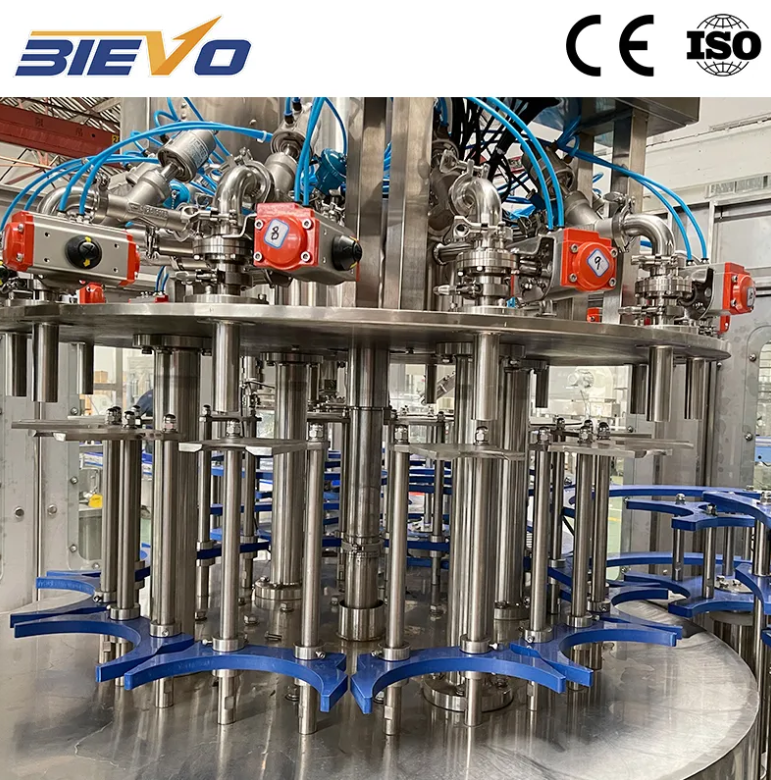
What Pressure Actually Does Inside a Beer Filler
Pressure inside a beer filling machine is not just a setting on a gauge. It is the physical force that keeps carbon dioxide dissolved in the liquid, controls flow rates, and determines whether foam stays manageable or spirals out of control. Beer at rest in a bright tank holds CO2 in solution because the headspace above it is maintained at a precise saturation pressure. The moment that beer enters the filler bowl and then moves toward the filling valves, every pressure fluctuation becomes a potential trigger for gas breakout. Too low a pressure in the bowl and CO2 rushes out of solution before the beer ever reaches the container. Too high and the filling speed drops because the differential that drives flow disappears. The relationship between pressure and dissolved gas follows Henry's Law, which states that the amount of gas dissolved in a liquid is directly proportional to the partial pressure of that gas above the liquid. This is not abstract physics. It shows up on the production floor as either smooth, consistent fills or as a packaging line drowning in foam.
The Bowl Pressure Sweet Spot and Why It Moves
Finding the correct bowl pressure is step one. Keeping it there throughout an entire production shift is the real challenge. The ideal pressure setting depends on several moving targets: the CO2 content of the beer, the product temperature at the filler inlet, and the altitude of the facility. A brewery in Mexico, situated well above sea level, once discovered that the pressure settings recommended by a European equipment manual simply did not apply. The lower atmospheric pressure at that altitude meant the filler bowl needed a proportionally higher gauge pressure to maintain the same absolute saturation pressure inside the tank. After recalibrating, the foam problems that had plagued the startup disappeared. Beyond altitude, the bowl pressure sweet spot shifts as product temperature drifts. A half degree Celsius warmer arriving at the filler demands a slight increase in head pressure to hold the CO2 in solution. Facilities that invest in real time pressure monitoring with automated feedback loops rather than manual regulator adjustments can compensate for these thermal shifts continuously. Those that rely on an operator checking a gauge once per hour usually find themselves chasing foam for the rest of the shift after a temperature excursion.
The Counter Pressure Cycle and Its Timing Secrets
The filling valve itself is where pressure control becomes most dynamic. Each container goes through a rapid sequence: initial pressurization, filling under counter pressure, and finally a controlled pressure release. The timing of each phase matters enormously. If the counter pressure gas flows in too quickly, it can blast a hole through the beer already in the filling tube, creating foam before a drop of product enters the bottle. If the filling phase opens before the container is fully pressurized to match the bowl, the beer hits a low pressure environment and immediately degasses. The vent phase, where displaced gas exits the container as beer flows in, must maintain enough back pressure to keep foam suppressed while allowing smooth gas escape. A common but often overlooked detail involves the snifter valve at the end of the cycle. This small mechanism releases a tiny puff of pressure after the liquid valve closes, creating a controlled foam rise that pushes oxygen out of the headspace. Too aggressive a snifter release and beer fountains over the bottle lip. Too gentle and oxygen pickup climbs, shortening shelf life. Each of these transitions happens in fractions of a second at high speed, and getting them right requires a filler that holds consistent pressures across all valve stations simultaneously.
|
Pressure Control Factor |
Optimal Condition |
Common Failure Mode |
|
Filler Bowl Head Pressure |
Maintained at saturation pressure matching product CO2 volume and temperature |
Pressure swings from inconsistent gas supply or leaking relief valves |
|
Counter Pressure Equalization |
Container pressurized to bowl pressure before liquid valve opens |
Insufficient pressurization time causing flash foaming on beer contact |
|
Snifter Release Pressure |
Gentle pressure drop creating about 2 to 3 centimeters of foam rise |
Overly aggressive release causing product loss through bottle overflow |
|
Gas Supply Purity and Stability |
Inert gas at consistent delivery pressure with adequate flow capacity |
Moisture or oxygen contamination altering gas behavior in the filler |
What Happens When Gas Supply Falls Short
The best beer filling machine on the market cannot compensate for a gas supply system that cannot keep up. CO2 or nitrogen must arrive at the filler at a steady pressure and with enough volume to handle peak consumption. When the supply line is undersized, the pressure at the filler inlet drops during high speed operation because the demand momentarily exceeds what the piping can deliver. That pressure sag translates directly into under pressurized containers and foam breakout. Moisture in the gas supply creates a different but equally frustrating problem. Water vapor in the CO2 line can form ice crystals at expansion points where gas pressure drops and temperature plummets. These tiny ice particles clog valve orifices and cause erratic pressure delivery to individual filling heads. A brewery in East Africa running a high speed canning line traced inconsistent fill levels to exactly this issue. Installing a properly sized gas dryer and a receiver tank upstream of the filler solved the problem within a single shift. The lesson is simple: the gas supply is not a utility to be treated as an afterthought. It is an integral part of the filling system.
How Filler Maintenance Directly Affects Pressure Stability
Pressure leaks do not announce themselves loudly. A worn O-ring on a filling valve stem might hiss quietly enough that nobody notices it over the ambient noise of a bottling hall. But that tiny leak bleeds pressure from the system continuously. Over dozens of filling cycles per minute, per head, the cumulative effect drags down bowl pressure and forces the control system to work harder to compensate. Eventually the leak grows worse, and the compensation reaches its limit. At that point the operator sees foam, blames the filler settings, and starts adjusting parameters that were correct to begin with. The real fix lies in a systematic maintenance program that tracks seal life by operating hours rather than waiting for visible failure. Filling valve rebuilds should include replacement of every dynamic seal and a pressure decay test on the assembled valve before it goes back onto the machine. Vent tubes, centering bells, and gas passages all need regular inspection for blockages or buildup that can restrict gas flow and create localized pressure anomalies at individual stations.
Engineering That Anticipates Real World Conditions
Pressure control in a beer filling machine is not something that can be bolted on after the fact. It is baked into the design of the filler bowl geometry, the valve actuation profiles, and the gas distribution manifold routing. The difference between a filler that runs stable across a full shift and one that needs constant tweaking often comes down to how well the manufacturer understood the physics of pressurized filling during the engineering phase. A company like BIEVO, with decades of experience building complete beverage filling and packaging lines, brings that understanding to every system it delivers. The pressure management architecture in BIEVO filling systems reflects years of field data collected from installations across multiple continents and climate zones. When the filler arrives on site, the commissioning process focuses on fine tuning rather than redesign. That head start means production targets are met sooner, and the packaging team spends less time interpreting pressure gauges and more time running product.