
Core Classification of Modern Oil Filling Machine Technologies
A modern oil filling machine relies on three mature metering frameworks to dispense edible, industrial and cosmetic oils with stable consistency, each built around distinct mechanical and electronic logic that responds differently to oil viscosity, temperature and foaming tendency. The full term oil filling machine covers piston volumetric, flowmeter volumetric and gravimetric weighing filling systems, the three dominant configurations deployed across mid-to-large bottling plants globally.
Piston volumetric units use servo-driven cylinders to push fixed oil volumes through filling nozzles, with stroke length dictating each fill quantity. Flowmeter variants track liquid flow rate via high-precision pulse sensors, paired with real-time temperature probes to offset density shifts caused by seasonal heat or cold. Gravimetric weighing systems bypass volume calculations entirely, measuring finished container weight through load cell sensors to lock exact oil mass regardless of fluid property fluctuations. Each design carries clear tradeoffs for production scale, oil type and compliance demands.
Step-by-Step Operational Workflow of Automated Filling Lines
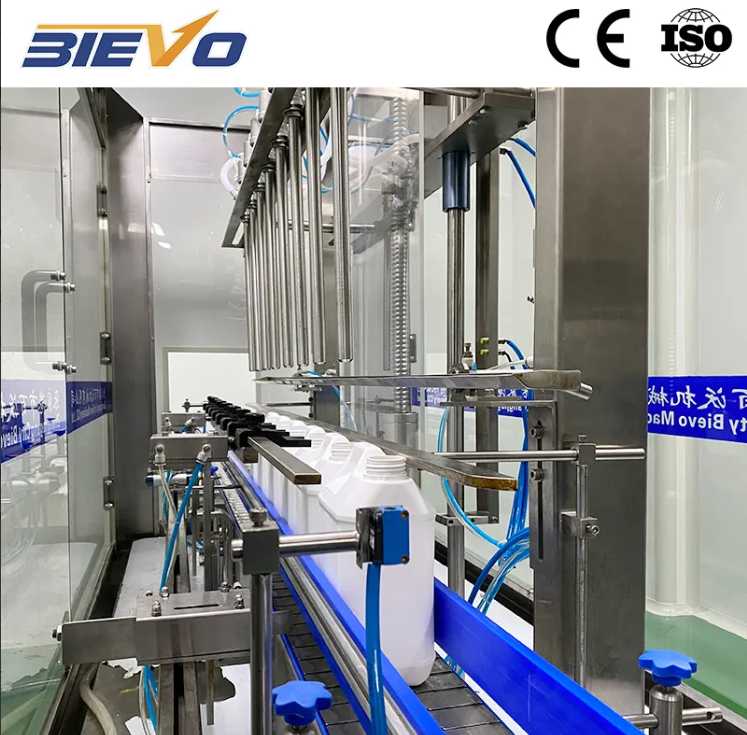
Every full-cycle run on a complete oil filling machine follows a standardized automated sequence controlled by PLC touchscreen logic, with zero manual intervention once production parameters are locked.
- Empty container conveyance: Plastic or glass bottles move along stainless steel conveyor belts, with positioning cylinders centering each bottle directly below filling nozzles to eliminate alignment gaps.
2.Submerged dual-speed filling: Nozzles descend deep into bottle necks to avoid splashing and foam buildup; initial fast flow delivers 80% of target volume, then flow throttles to slow speed for precise topping off.
3.Anti-drip vacuum retraction: Once metering targets hit, pumps cut power and built-in vacuum channels pull residual oil back into pipeline circuits, eliminating sticky oil droplets on bottle rims.
- Bottle ejection and handoff: Filled containers shift forward to downstream capping, labeling and coding stations while empty bottles slide into filling positions to sustain continuous throughput.
This sequential design cuts material waste significantly compared to semi-automatic pedal-operated oil filling equipment widely used in small-scale workshops a decade ago.
Technical Mechanism Behind Temperature and Density Compensation
Oil expands and contracts sharply with ambient temperature swings, creating major metering drift risks for unmodified filling hardware. A standout advantage of upgraded oil filling machine models is integrated real-time compensation logic engineered to neutralize this natural fluid behavior. Flowmeter-equipped machines feed live temperature readings from pipeline probes into onboard microprocessors, which automatically adjust total dispensed volume to maintain consistent net oil mass. Gravimetric systems avoid this correction step entirely because load cells measure final weight directly, removing density variance as a source of error. Piston machines rely on pre-programmed viscosity correction curves input by technicians during production setup, requiring periodic recalibration when oil batches change.
A renovation project at a medium-sized edible oil factory in southern Guangdong highlighted this gap in older equipment. The plant’s legacy piston filling lines ran without temperature compensation, recording consistent overfilling of 18–25 ml per 5-liter bottle during summer high-temperature months. After retrofitting flowmeter modules with thermal tracking, excess fill volume dropped below 2 ml per container, slashing monthly raw material loss by over 1,200 liters of refined soybean oil.
Performance Comparison of Three Main Oil Filling Machine Types
|
Filling Type |
Typical Accuracy Margin |
Best Viscosity Match |
Hourly Throughput (5L Bottles) |
Core Limitation |
|
Servo Piston Volumetric |
±0.5% |
High-viscosity oils (peanut, sesame) |
1,800–2,400 |
Requires frequent calibration for temperature shifts |
|
Digital Flowmeter Volumetric |
±0.3% |
Medium/low-viscosity oils (soybean, sunflower) |
2,200–3,000 |
Foamy oils create minor flow counting bias |
|
Gravimetric Weighing |
±0.2% |
All viscosity grades, including foamy blends |
1,200–1,600 |
Slower cycle speed, higher upfront equipment cost |
Per data published in the 2024 China Liquid Packaging Machinery Industry White Paper, gravimetric filling systems hold 21% market share among large-scale edible oil manufacturers, while flowmeter volumetric oil filling machine products capture 47% of mid-tier factory installations due to balanced speed and precision. National food measurement standards mandate all commercial oil bottling equipment maintain error below ±0.5%, a threshold all three categories can satisfy with proper maintenance.
Anti-Foam and Anti-Drip Auxiliary Mechanical Logic
Foam generation during filling creates false volume readings and messy, unmarketable finished bottles, so modern oil filling machine platforms integrate two specialized mechanical sub-systems to counteract this issue. Submerged descending nozzles stay beneath rising liquid levels through the entire fill cycle, blocking air from mixing with oil to cut foam formation by over 70% versus overhead fixed nozzles. Secondary vacuum retraction valves activate milliseconds after filling cutoff, pulling stray oil film from nozzle tips back into storage pipelines to prevent rim staining and conveyor belt contamination.
For ultra-viscous aromatic oils like cold-pressed camellia oil, optional pipeline heating jackets integrate into filling machine frames to lower fluid resistance; warmer oil flows smoother through narrow nozzles without clogging or uneven dispensing. These auxiliary modules add minimal footprint to production lines while drastically reducing post-filling cleaning labor overhead.
Real-World Limitations of Modern Oil Filling Machine Systems
No single oil filling machine design delivers perfect performance across every production scenario, and recognizing inherent constraints prevents costly misconfiguration during factory layout planning. Gravimetric weighing units deliver unmatched accuracy but feature slower cycle times, making them unsuitable for facilities prioritizing maximum hourly output above all other metrics. Flowmeter setups struggle with heavily aerated crude oil blends, as trapped air bubbles skew flow sensor pulse counting results and require secondary defoaming tanks upstream. Servo piston units rely on rubber sealing gaskets inside cylinder chambers, which degrade after roughly 6,000 operating hours and demand scheduled replacement to avoid rising measurement deviation.
Even premium automated filling hardware cannot fully eliminate minor error sources including uneven bottle base flatness, inconsistent oil batch purity and voltage fluctuation on factory power grids. Standard industry practice recommends daily 10-minute calibration checks to hold fill variance within advertised tolerance ranges.
Equipment engineered by BIEVO unifies the core metering strengths of volumetric and gravimetric oil filling machine architectures within modular, interchangeable frames. Its production facility spanning 7,000 square meters supports custom mechanical tweaks for specialized oil formulations, with over 50 patented component designs optimizing thermal compensation, anti-foam nozzle geometry and vacuum retraction stability for long-term continuous production runs.
Table of Contents
- Core Classification of Modern Oil Filling Machine Technologies
- Step-by-Step Operational Workflow of Automated Filling Lines
- Technical Mechanism Behind Temperature and Density Compensation
- Performance Comparison of Three Main Oil Filling Machine Types
- Anti-Foam and Anti-Drip Auxiliary Mechanical Logic
- Real-World Limitations of Modern Oil Filling Machine Systems