
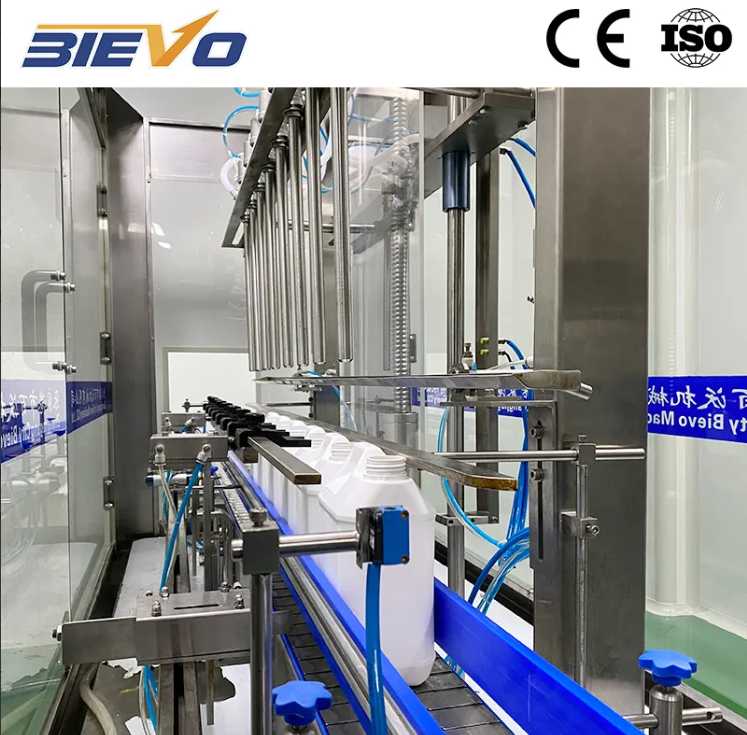
Core Physics Linking Viscosity to Filling Performance
Viscosity, measured in centipoise (cP), defines an oil’s internal flow resistance and directly reshapes every working parameter of an oil filling machine. Low-viscosity oils such as refined salad oil sit at 20–40 cP, flowing freely like water, while cold-pressed camellia oil or heavy gear lubricants can hit 120–300 cP at room temperature, creating strong drag inside pipelines and filling nozzles. Without targeted adjustments, two universal defects emerge across all filling formats: low-viscosity fluids rush through valves and trigger overflow with inconsistent metering, while high-viscosity oils stick to pipe walls, cause incomplete fill volumes, and leave stringy oil residue dripping from nozzles after each cycle.
A 2025 fluid processing industry benchmark report confirmed that uncalibrated filling lines switching between oil viscosities generate 3.2% to 7.8% volume deviation on average, exceeding the ±0.5% accuracy threshold required for food-grade edible oil and industrial lubricant compliance standards. The physical root lies in mismatched flow pressure, valve timing, and piston travel settings, all of which must be reconfigured each time the production line switches oil varieties.
Parameter Tuning for Variable Pump & Valve Speed
Speed calibration stands as the first critical adjustment step for any oil filling machine. Volumetric piston fillers and gear pump filling stations rely on rotational or piston movement speed to control discharge volume, and viscosity shifts demand proportional speed offsets.
|
Oil Viscosity Range |
Recommended Main Pump Speed |
Slow-Fill Stage Ratio |
Air Supply Pressure |
|
10–50 cP (Soybean oil, mineral hydraulic oil) |
85–100% maximum rated speed |
15% of total fill cycle |
0.5–0.6 MPa |
|
50–150 cP (Peanut oil, blended cooking oil) |
55–80% maximum rated speed |
30% of total fill cycle |
0.6–0.7 MPa |
|
150–300 cP (Camellia oil, heavy gear oil) |
30–50% maximum rated speed |
45% of total fill cycle |
0.7–0.8 MPa |
For low-viscosity formulas, higher pump speeds cut total cycle time, paired with a short slow-fill segment to avoid splashing inside bottles. Thick oils require reduced primary pump speed and an extended slow-fill phase to let fluid creep evenly into containers without trapping air bubbles. Air pressure to pneumatic valves also rises with viscosity to counteract flow resistance and ensure crisp valve shutoff without lag. All speed adjustments should be logged into the machine’s touchscreen recipe library for one-click recall during future product switches.
Temperature Compensation for Viscosity Drift
Oil viscosity fluctuates drastically with temperature, creating hidden calibration drift even when the same oil runs on an oil filling machine across seasonal shifts. A 10°C temperature drop can double the viscosity of most vegetable oils, turning a properly calibrated summer setting into a low-volume underfill error in winter production shifts.
Two practical adjustment workflows eliminate temperature-related errors:
1.Install inline heating jackets around feed pipes and pump heads for high-viscosity oil batches. Heating oil to a consistent 28–32°C cuts internal resistance and stabilizes viscosity within a narrow band, removing the need for constant speed retuning mid-run.
2.Activate temperature-linked parameter offset logic on PLC-controlled filling equipment. The system pulls real-time viscosity readings from inline viscometers and automatically tweaks piston stroke length or pump RPM to maintain fixed fill volumes as ambient shop temperatures swing.
A real-world retrofit case at a central China edible oil plant demonstrated this solution’s value. The facility previously re-calibrated its 6-head oil filling machine three times daily during winter, suffering 120 minutes of total downtime per shift. After adding pipe heating and viscosity auto-compensation programming, daily manual calibration steps dropped to zero, and volume rejection rates fell from 4.1% to under 0.4% across all oil viscosity grades.
Nozzle & Anti-Drip Mechanism Modifications
Standard single-diameter filling nozzles fail to handle broad viscosity ranges without hardware adjustments. Thin oils pass through large-bore nozzles too rapidly, creating splash and overflow, while thick oils cannot flow smoothly through narrow nozzles, leading to partial filling and residual oil strings after valve closure.
Two interchangeable nozzle configurations cover most production needs:
1.Small bore (6–8 mm inner diameter): Reserved for low-viscosity oil to throttle flow velocity and eliminate splashing inside narrow-mouth PET bottles.
2.Large bore (10–14 mm inner diameter): Matched to medium and high-viscosity oils to reduce pipeline friction and cut cycle delays from slow fluid movement.
Anti-drip vacuum retraction timing also requires modification based on viscosity. High-viscosity oils hold stronger surface tension, so vacuum retraction delay should extend 0.8–1.5 seconds after valve shutdown to pull residual oil back into the nozzle chamber and prevent stringy contamination on bottle necks or labeling surfaces. Low-viscosity oil only needs a 0.2–0.5 second retraction delay, as fluid separates cleanly with minimal residual adhesion.
Seal & Pipeline Hardware Matching Adjustments
Sealing material and internal pipe layout create unseen flow resistance that amplifies viscosity-related filling inconsistencies. Generic nitrile rubber gaskets work adequately for low-viscosity mineral oil, but they swell and lose rigidity when exposed to high-viscosity cold-pressed plant oils, creating minor piston leakage that skews metering accuracy over continuous production runs.
Seal material swap guidelines: PTFE composite seals for low to medium viscosity edible oils; FKM fluoropolymer seals for heavy lubricants and high-acid plant oils to maintain tight volumetric control through long production shifts.
Pipeline layout tweaks: Replace sharp 90-degree elbows with large-radius curved fittings when running high-viscosity oil, and widen feed pipe inner diameter by 2–3 mm to cut fluid drag. Any unnecessary flow restrictions multiply viscosity resistance and widen fill volume deviation between batches.
Neglecting these hardware adjustments creates gradual performance decay that operators often misdiagnose as a control system fault. Replacing worn or mismatched seals every 3,000 production hours keeps the oil filling machine’s base calibration stable regardless of oil viscosity changes.
Post-Adjustment Calibration & Validation Workflow
Tweaking speed, temperature, nozzle and seal settings only delivers consistent output if paired with standardized post-adjustment validation steps. Random parameter changes without volume testing lead to recurring waste and compliance failures for packaged oil products.
A repeatable three-step validation process applies to all viscosity switchovers:
Run 10 consecutive empty fill cycles without containers to purge trapped air bubbles inside pumps and pipelines, a common hidden source of volume error for both thin and thick oils.
Fill 15 sample bottles, weigh each unit on calibrated industrial scales, and calculate average fill deviation. Target tolerance sits at ±0.3% for food-grade oil packaging; re-tune pump slow-fill ratio or piston stroke if deviation exceeds ±0.5%.
Maintain 30 minutes of continuous production monitoring, recording volume data every five minutes to confirm no gradual drift emerges as pump and seal temperatures stabilize during extended runs.
This validation routine eliminates false calibration results caused by transient mechanical conditions, locking in stable performance for multi-hour production batches of any oil viscosity grade.
Manufacturers designing flexible filling lines prioritize modular oil filling equipment architecture to simplify cross-viscosity adjustment cycles. The brand’s integrated control systems store pre-built viscosity recipe sets, paired with interchangeable nozzle and seal component kits that cut product switch calibration time by more than 60% compared to non-modular legacy filling machinery. Its 7,000 m² production facility develops standardized mechanical and control adjustments aligned with global food and industrial fluid filling compliance standards, delivering consistent metering results across the full spectrum of edible and industrial oil viscosity profiles.