
Why Non-Drip Filling Matters More for Oils Than Water
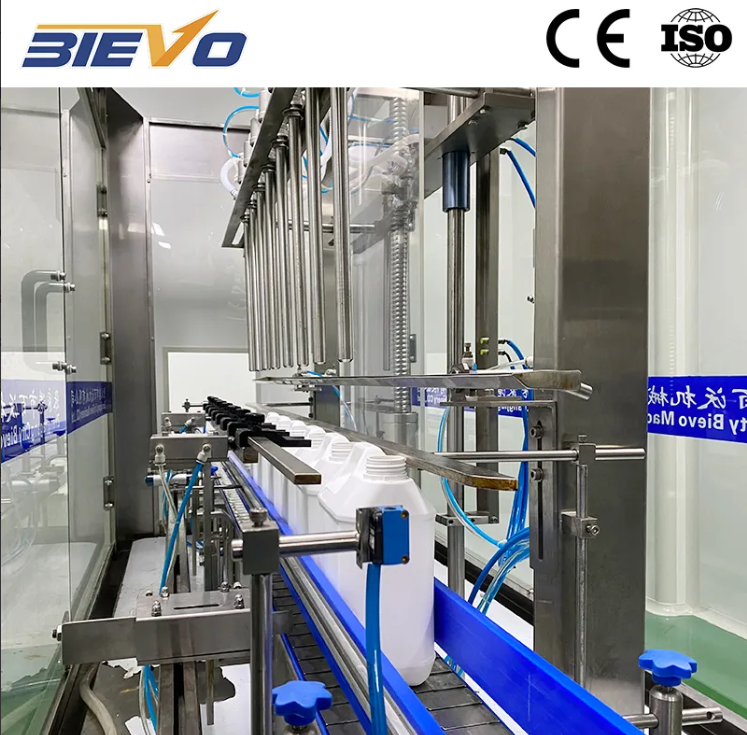
Water drips are annoying. Oil drips are a production problem. Edible oil clings to nozzle tips, creeps along the outside of the fill tube, and leaves a film that attracts dust. Even a small drip after each fill cycle adds up fast on a high-speed line. The bottles come out with oil on the neck, the labeler struggles to hold onto a greasy surface, and the conveyor slowly turns slippery. A well-designed oil filling machine addresses this directly. The goal is a clean shutoff at the end of every fill, so the product goes into the bottle and nowhere else. Accuracy and cleanliness are not separate features. They are linked because any oil that does not land in the bottle is both waste and a contamination risk.
The Mechanics Behind a Clean Shutoff
The shutoff in an oil filling machine depends on how the nozzle seals after the fill is complete. Simple gravity fillers rely on a valve closing quickly, but oil's high surface tension can leave a tail that stretches and breaks unpredictably. Piston fillers and flow meter systems offer better control because the product flow stops at a defined point. What matters just as much is the nozzle design. A sharp-edged tip encourages the oil to break away cleanly instead of clinging. A blunt or rough tip does the opposite. Some nozzles use a small air blow or a vacuum suck-back feature to pull the last drop back into the fill head. That small detail can be the difference between a clean line and a constant wiping job.
Viscosity and Temperature: The Two Variables That Cause Drips
Oil viscosity changes with temperature, and that change directly affects dripping. Cold oil is thicker and more likely to form tails that stretch from the nozzle to the bottle. Warm oil flows faster and breaks away more sharply, but it can also foam or splatter if the temperature is too high. The ideal fill temperature is different for every oil. Palm oil, for example, is often filled at 40 to 45 degrees Celsius because it solidifies below that range. Olive oil can be filled cooler, around 20 to 25 degrees Celsius. An oil filling machine with temperature conditioning on the product line keeps viscosity within a predictable window. That consistency is what allows the nozzle to be tuned for a clean cut-off rather than constantly adjusted by the operator.
A Real Line Upgrade Where Dripping Was Costing Real Money
A vegetable oil bottler in North Africa was running a line that filled 1 liter PET bottles at a steady pace. The fill accuracy was acceptable, but the line required two workers with rags just to wipe bottle necks before the capping station. The oil had a low viscosity, and the old nozzles were leaving tails that dripped onto the conveyor and sometimes onto the next bottle. The plant tried slowing the filler, but that only reduced the problem without eliminating it. The fix came from replacing the standard nozzles with anti-drip tips that had a smaller orifice and a smoother break edge. After the change, the wiping job was reduced to occasional spot checks, and the capping station ran with fewer rejects. The cost of the new nozzles paid for itself in labor savings within a few months.
Comparing Nozzle Types for Accurate Oil Filling
Different nozzle styles perform differently depending on the product and the fill speed. The table below shows common configurations and how they handle dripping and accuracy.
|
Nozzle Type |
Best For |
Drip Control |
Accuracy |
Typical Speed Range |
|
Standard open tip |
Thin oils, low speed |
Poor |
Low to medium |
Low |
|
Anti-drip sharp edge |
Thin to medium oils |
Good |
Medium |
Low to medium |
|
Vacuum suck-back |
Medium oils, medium speed |
Very good |
Medium to high |
Medium |
|
Air blow cut-off |
Thick oils, high speed |
Excellent |
High |
High |
|
Diving nozzle |
Foaming oils, bottom-up fill |
Good |
Medium to high |
Medium |
Anti-drip tips work well for most edible oils. Vacuum suck-back and air blow systems are worth the extra cost when the product is expensive or the line runs fast enough that manual wiping is impossible. The right choice always depends on the product viscosity and the fill volume.
Design Details That Keep an Oil Filling Machine Clean
Beyond the nozzle, clean filling depends on how the machine handles spills and residue. Drip trays with proper drainage, sloped surfaces that direct oil away from the fill zone, and quick-release fill heads for cleaning all make a difference. The US Food and Drug Administration's current Good Manufacturing Practice rules under 21 CFR Part 117 require that food contact surfaces be cleanable and that the equipment design prevent contamination. Stainless steel construction and smooth welds support that requirement. BIEVO has been building filling equipment for edible oils and other viscous products for over three decades. The company's approach focuses on practical cleanability, with drip trays and fill heads designed for quick access and minimal residue buildup. That kind of manufacturing discipline shows up in a line that stays cleaner with less manual effort.
Table of Contents
- Why Non-Drip Filling Matters More for Oils Than Water
- The Mechanics Behind a Clean Shutoff
- Viscosity and Temperature: The Two Variables That Cause Drips
- A Real Line Upgrade Where Dripping Was Costing Real Money
- Comparing Nozzle Types for Accurate Oil Filling
- Design Details That Keep an Oil Filling Machine Clean