
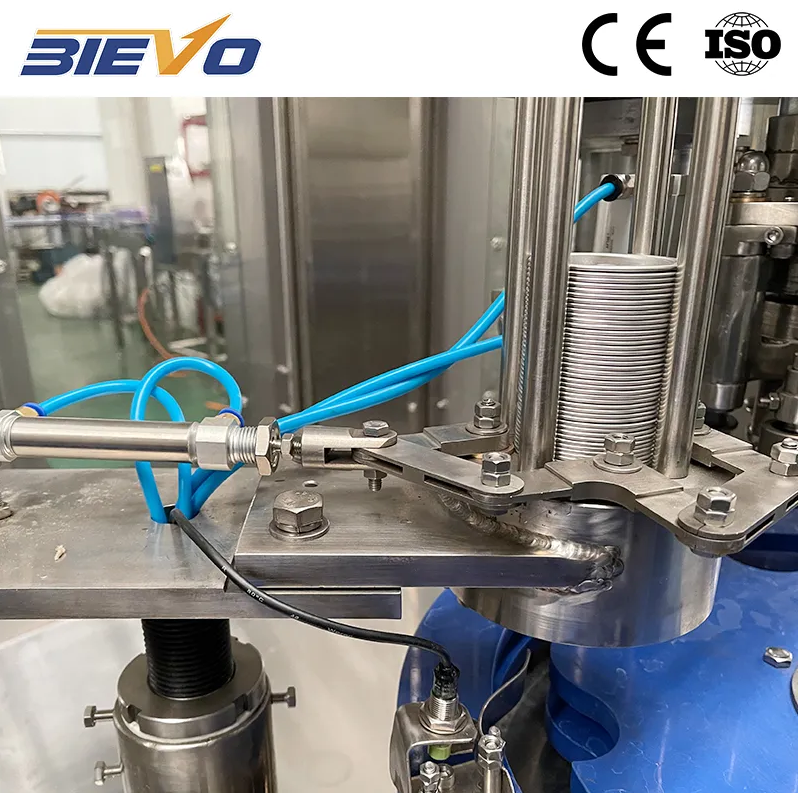
Treat Filling Speed and Seal Quality as One Problem
Most line managers treat speed and quality as opposite ends of a dial. On a can filling line, that mindset causes more harm than good. A filler can be pushed faster, but if the seamer cannot hold overlap within specification, the line simply produces scrap at a higher rate. The real target is maximum stable speed, meaning the highest throughput that can be held for an entire shift without rising defect rates. That requires looking at the whole sequence from depalletizer to seamer discharge as one connected system. When improvements remove bottlenecks instead of simply cranking up the filler, quality tends to stay intact. Many plants discover that the filler was never the limiting factor in the first place.
Product Temperature Is a Hidden Speed Killer
Temperature has a direct effect on foam formation and fill accuracy. For carbonated beverages, warmer liquid releases dissolved CO2 more aggressively, which forces the filler to slow down to avoid overfoaming and underfills. A brewery in Southeast Asia ran its canning line with incoming product at 7 degrees Celsius and could not pass 9,000 cans per hour without seeing fill level drift. After adding a plate heat exchanger to bring the product down to 3.5 degrees Celsius at the filler inlet, the same line held 11,000 cans per hour with no increase in underfill rejects. That is a 20 percent gain from infrastructure, not from modifying the filler itself. The American Society of Brewing Chemists has long recommended keeping dissolved oxygen pickup below 50 parts per billion for packaged beer, and lower filling temperatures help achieve that by reducing foaming and air entrainment. The same principle applies to many other carbonated drinks.
Valve Tuning and Backpressure Often Beat Bigger Motors
Many people assume a faster line needs a larger filler or a more powerful drive motor. That is rarely the first move. In a rotary filler, the filling valves control how quickly product enters each can. If the vent tube is partially clogged or the valve springs are worn, the filler will struggle at any speed regardless of motor capacity. Backpressure settings also matter a great deal. Too much backpressure on a carbonated product can create turbulence and foaming at the fill point. Too little backpressure can cause CO2 breakout inside the valve. Fine-tuning these settings, along with scheduled replacement of small wear parts like O-rings and springs, often unlocks more usable speed than a mechanical upgrade. The adjustment process requires patience and careful observation, but it costs far less than buying new equipment.
Where Different Speed Improvements Actually Deliver
Not all speed levers are equal. The table below compares common options based on observed results across multiple beverage lines. These are reference ranges, not guaranteed outcomes, because every line has its own bottlenecks.
|
Improvement Area |
Typical Speed Gain |
Main Risk |
Relative Cost |
|
Lowering product temperature 2 to 4 degrees C |
10 to 20 percent |
Requires additional heat exchange capacity |
Medium |
|
Rebuilding or replacing filling valves |
5 to 15 percent |
Downtime during changeover |
Low to medium |
|
Adding buffer conveyors before the seamer |
3 to 8 percent |
Layout modification and floor space |
Medium |
|
Synchronizing filler and seamer timing |
5 to 10 percent |
Requires a skilled technician |
Low |
|
Improving can feed stability at the depalletizer |
4 to 12 percent |
Upstream tuning effort |
Low |
If the real bottleneck is a slow labeler or an undersized pasteurizer, none of these actions will produce much gain. That is why a proper line audit comes before any speed project.
A Real Case Where Slowing Down One Section Sped Up the Line
At a contract packing facility in the Middle East, a can filling line was experiencing frequent jams just before the seamer. The operators responded by speeding up the discharge conveyor to clear the backlog. That made the jams worse because cans were arriving at the seamer with unstable spacing and occasional double hits. The fix involved slowing down the filler slightly, rebuilding the starwheel transfer, and adjusting the timing screw to match the seamer's infeed pitch. After those changes, the line ran at a lower filler RPM but produced 8 percent more good cans per shift. The lesson is counterintuitive but consistent across many plants. Speed at the filler matters less than stability at the transfer points. A smooth, predictable can flow allows the seamer to work correctly, which in turn protects seal quality.
Practical Steps That Preserve Quality While Raising Output
Start by mapping the line to find the real constraint. Check fill level data from the past 30 days, not just the target speed on the control panel. Look for patterns like increasing rejects in the afternoon or after product changeovers. Then focus on small adjustments that reduce variation rather than pushing every motor to its limit. Keep seamer tear-downs on schedule even when the line speeds up, because higher throughput amplifies any small seam defect. BIEVO has been involved in enough canning line projects to know that the best speed gains come from better integration, not from asking one machine to do more than it was designed for. The company's approach includes testing can and product combinations before installation and providing operator training that emphasizes stable transfer and consistent fill parameters. That kind of support helps beverage factories raise output without turning quality into a gamble.
Table of Contents
- Treat Filling Speed and Seal Quality as One Problem
- Product Temperature Is a Hidden Speed Killer
- Valve Tuning and Backpressure Often Beat Bigger Motors
- Where Different Speed Improvements Actually Deliver
- A Real Case Where Slowing Down One Section Sped Up the Line
- Practical Steps That Preserve Quality While Raising Output