
Container Rinsing and Thermal Conditioning Dynamics
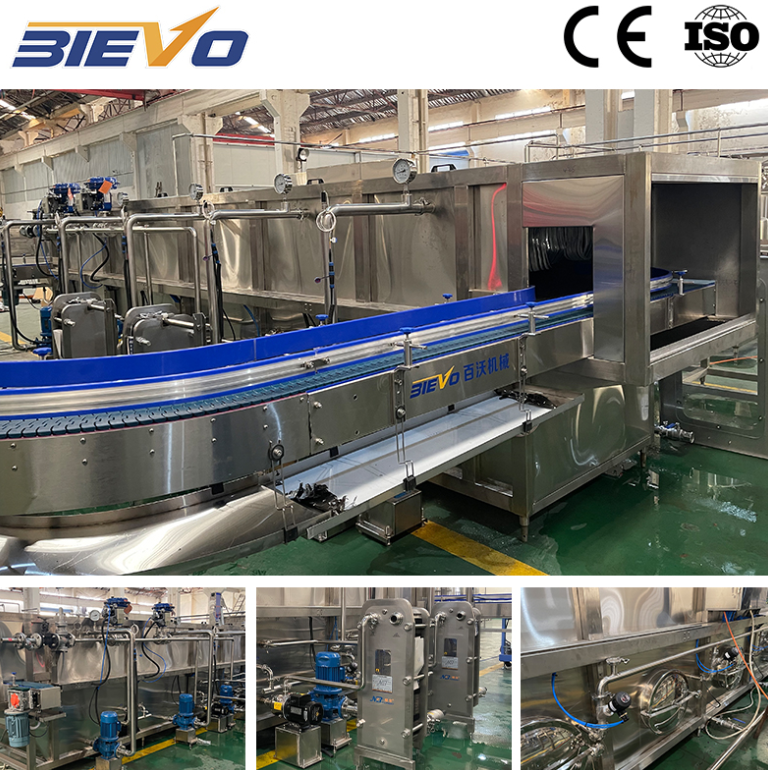
High-speed liquid packaging lines begin with physical container preparation to preserve beverage hygiene, remove foreign matter, and prevent thermal shock. Empty bottles travel through infeed star-wheels into a high-speed rotary rinsing carousel where mechanical grippers clamp and invert each container by 180 degrees. High-pressure spray nozzles inject sterile water, ozonated liquid, or sanitized compressed air directly into the bottle cavity, dislodging ambient dust particulates and micro-debris before liquid introduction. When handling hot-fill fruit juices, pre-heating glass or heat-resistant PET bottle walls becomes critical to prevent container structural deformation and micro-fractures caused by sudden thermal gradients. Modern bottle handling systems utilize temperature-controlled recirculating water circuits that elevate container inner wall temperatures in incremental thermal zones. Operating a high-performance juice filling machine requires seamless synchronization between the rinsing carousel, bottle invert mechanism, and main filling rotary bowl. Precise mechanical timing screws guide containers smoothly along the conveyor belt, eliminating acceleration spikes that cause bottle tipping during high-speed transfer.
Liquid Dosing Mechanics and Valve Actuation Principles
The core mechanism of non-carbonated beverage bottling centers on liquid transfer control, where gravity, piston displacement, or magnetic flow metering regulates fluid volume inside every container. In traditional gravity overflow filling systems, liquid flows from an overhead constant-level bowl into the bottle once mechanical centering cups create a tight elastomeric seal against the bottle neck. Atmospheric pressure pushes product down along internal container walls, while displaced air vents back into the bowl headspace through a central air return tube. Once liquid reaches the lower orifice of the vent tube, flow stops naturally due to fluid pressure equilibrium. According to technical documentation from the Packaging Machinery Manufacturers Institute, electromagnetic flow meter valves offer superior volumetric accuracy by eliminating internal moving parts, reducing mechanical wear, and preventing cross-contamination in fibrous pulp liquid lines.
- Mechanical bottle lift pedestals compress spring-loaded valves, opening fluid channels without requiring motorized actuators.
- Electromagnetic flow sensors count fluid volume pulses in real time, signaling solenoid valves to close upon reaching precise target quantities.
- Servo-driven piston cylinders draw fixed liquid volumes into honed chambers before dispensing product into open bottle necks.
|
Dosing Principle |
Flow Metering Volumetric |
Gravity Overflow System |
Piston Displacement Unit |
|
Viscosity Compatibility |
Up to 800 cP with pulp |
Low viscosity below 100 cP |
High viscosity up to 5000 cP |
|
Filling Volumetric Accuracy |
+/- 0.2 percent |
+/- 1.0 percent |
+/- 0.5 percent |
|
Mechanical Wear Rate |
Minimal without sliding seals |
Low mechanical wear |
Moderate seal friction wear |
|
Cleaning Flexibility |
Rapid CIP passage without tear-down |
Requires manual vent tube cleaning |
Demands full cylinder flush |
Hot Filling Recirculation and Thermal Loop Control
Thermal management during liquid transfer directly impacts product sterility, liquid viscosity, and beverage taste profiles. Hot fill lines process high-acid juices at temperatures ranging between 85 and 92 degrees Celsius to achieve commercial pasteurization within the package without added chemical preservatives. Maintaining fluid temperatures strictly above critical microbicidal thresholds requires continuous liquid recirculation through the main filling bowl whenever down-stream packaging line stoppages occur. Temperature sensors installed inside valve bodies trigger three-way pneumatic recirculation valves when fluid drops below 82 degrees Celsius, diverting cooler liquid back to tubular heat exchangers for instant re-heating. This thermal loop prevents under-temperature product from entering bottles, protecting product integrity across fluctuating production schedules.
Operational Field Case Study on Pulp Clogging and Valve Redesign
During a facility upgrade at a tropical nectar bottling plant in South America, line technicians experienced frequent valve clogging and fill height variations across a twenty-four head filling carousel. The facility processed mango and passion fruit juices containing high pulp and fiber concentrations. Technical inspection revealed that standard gravity overflow vent tubes trapped fibrous pulp inside narrow air return channels, causing air locks and premature valve shutoff. The engineering team replaced standard vent tubes with custom non-contact electromagnetic flow valves featuring smooth internal bores without internal obstructions. Additionally, pneumatic anti-drip cut-off nozzles were installed on valve tips to handle fibrous strands cleanly. These adjustments eliminated valve clogging entirely, restored volume accuracy to within plus or minus 0.5 percent, and allowed continuous multi-shift production without manual valve flushes or line shutdowns.
Steam Injection Capping and Hermetic Sealing Systems
Securing bottle closures requires precise mechanical torque control and thermal oxygen displacement within the container headspace. Once bottles exit the filling turret, transfer star-wheels guide containers into the rotary capping turret. A dedicated cap sorter feeds plastic screw caps or aluminum roll-on closures down an inclined chute toward a pick-and-place applicator. Before cap placement, high-pressure steam injection sweeps across the open bottle neck, displacing trapped ambient air and creating a partial vacuum upon steam condensation inside the sealed bottle. Vacuum conditions preserve vitamin content and extend shelf life by inhibiting oxidative degradation. Magnetic capping heads featuring adjustable hysteresis clutches apply uniform application torque, forming a hermetic seal that prevents oxygen ingress and protects beverage flavor throughout extended shelf storage.
Facility Line Integration and Processing Performance
Achieving optimal packaging performance demands harmonizing beverage processing, bottle handling, thermal sanitation, and automated control logic into a single cohesive line layout. Disconnects between pasteurization units, bottle blow molders, labeling machinery, and case packers create operational bottlenecks that increase product scrap and thermal stress on liquid product. Turnkey engineering aligns conveyor motor drives, electronic PLC recipes, and automated clean-in-place sequences under a unified operational umbrella. Equipment engineering and line integration from BIEVO combine robust precision components with adaptable automation systems, supporting beverage producers with reliable production stability across diverse liquid formulas and container formats.
Table of Contents
- Container Rinsing and Thermal Conditioning Dynamics
- Liquid Dosing Mechanics and Valve Actuation Principles
- Hot Filling Recirculation and Thermal Loop Control
- Operational Field Case Study on Pulp Clogging and Valve Redesign
- Steam Injection Capping and Hermetic Sealing Systems
- Facility Line Integration and Processing Performance