
Balancing Gas Dissolution and Pressure Stability in High-Speed Bottling
Managing dissolved carbon dioxide demands strict thermal control and precise pressure balancing across the entire processing loop. Carbonated soft drinks require carbonation levels ranging between 3.0 and 4.2 volumes of gas dissolved per volume of liquid. Maintaining dissolved gas in solution during transfer requires keeping beverage temperatures below 4 degrees Celsius while applying counter-pressure inside the filling valves. When liquid temperatures rise by even two degrees, gas solubility drops sharply according to Henry's Law, causing violent foaming at the discharge nozzles. This disturbance triggers fill volume inconsistencies and excessive product loss, severely degrading overall processing efficiency. Integrating automated proportioning units with plate heat exchangers ensures that incoming liquid stays within narrow thermal bands. Pressurized buffer tanks equipped with proportional modulating valves keep head pressure steady, preventing sudden pressure drops that release dissolved gas before liquid enters the bottle.
Mechanical Dynamics of Isobaric Counter-Pressure Valves
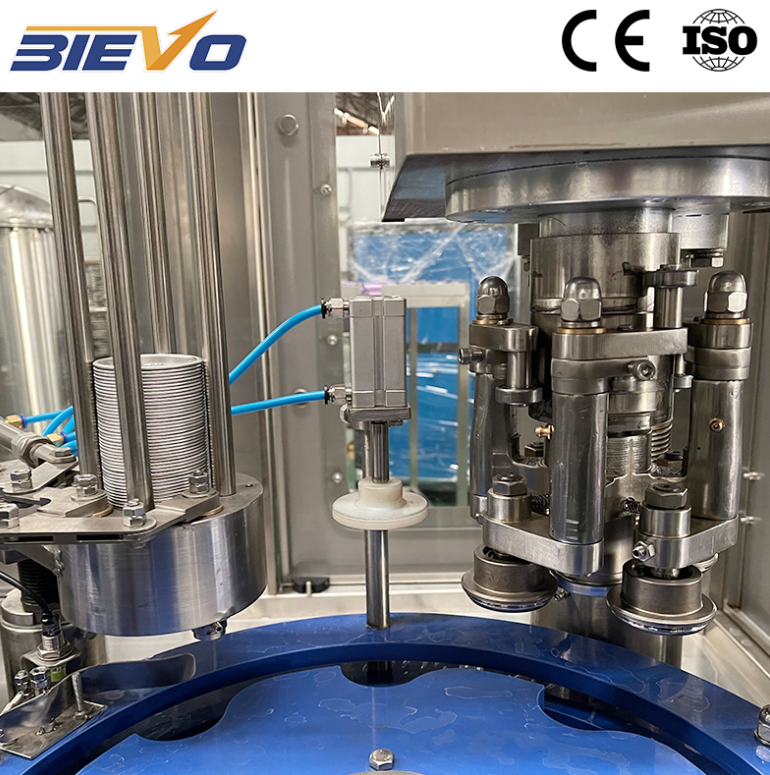
Operating an isobaric carbonated beverage filling machine involves a continuous four-stage mechanical sequence. The process begins with bottle sealing, where pneumatic lifters push the container finish against a flexible neck gasket to form an airtight seal. The second stage opens a gas channel to equalize pressure between the bowl and the bottle using carbon dioxide or compressed air. Once pressure equalizes, liquid valves open under mechanical spring force, allowing gravity to guide product down along the internal container walls in a smooth spiral path. Air inside the container vents back into the reservoir headspace through a dedicated vent tube. When liquid reaches the bottom opening of the vent tube, flow stops naturally without requiring electronic sensors. The final stage involves controlled snifting, where pressure releases gradually to prevent liquid surging during bottle discharge.
|
Operational Parameter |
Low-Pressure Isobaric |
High-Pressure Counter-Pressure |
Servo-Mechanical Flow Meter |
|
Operating Pressure Range |
0.25 to 0.35 MPa |
0.40 to 0.60 MPa |
0.20 to 0.50 MPa |
|
Carbonation Handling Limit |
Up to 3.2 Volumes |
Up to 4.5 Volumes |
Up to 4.8 Volumes |
|
Average Neck Space Oxygen |
0.8 to 1.2 ppm |
0.3 to 0.5 ppm |
0.15 to 0.3 ppm |
|
Mechanical Changeover Time |
45 to 60 Minutes |
30 to 45 Minutes |
10 to 15 Minutes |
Line Integration Challenges in Regional Bottling Facilities
Scaling production from manual or semi-automated operations to high-throughput lines introduces integration bottlenecks across civil engineering and utility distribution systems. Bottlers frequently underestimate the utility demands of high-volume carbonation during facility planning. Inadequate boiler capacity or insufficient chilled water flow rate causes filling line halts, as temperature fluctuations stall the counter-pressure cycle and compromise liquid saturation. Piping design also plays a critical role, as sharp ninety-degree elbows and unpolished internal welds induce cavitation bubbles that destabilize gas-saturated liquids. Layout planning must incorporate adequate accumulation conveyors between blow molders, fillers, and rotary cappers to absorb micro-stoppages without forcing upstream equipment shutdowns or causing physical bottle damage.
Operational Case Study on Secondary Vent Tube Modifications
During an expansion project at a beverage plant in South America, production operators experienced severe fill height variation and excessive foaming on a newly installed counter-pressure line. The facility processed carbonated mineral water at 3.8 volumes of carbonation under demanding environmental conditions. Inspection showed that the standard vent tube geometry allowed liquid droplets to cling to the inner rim, creating partial vapor locks during rapid gas venting and disturbing the liquid equilibrium. The engineering team replaced the standard vent tubes with custom tapered stainless steel needles featuring hydrophobic tip coatings. Additionally, snifting valve release timing was modified from a single burst to a two-step pressure release sequence. These physical and operational adjustments eliminated foaming, reduced fill height variance to within plus or minus one millimeter, and allowed stable operating speeds without product splash.
Industry Standards and Oxygen Control Protocols
Controlling dissolved oxygen levels remains essential for extending product shelf life and preserving delicate flavor stability over extended storage periods. Research conducted by the International Society of Beverage Technologists demonstrates that total package oxygen levels exceeding 0.5 parts per million accelerate ascorbic acid degradation and trigger off-flavors within weeks of packaging. Modern isobaric filling circuits utilize double pre-evacuation procedures before carbon dioxide pressurization. High-capacity vacuum pumps evacuate residual ambient air from the container, replacing it with food-grade carbon dioxide gas before the liquid valve opens. This double-stage cycle reduces neck space oxygen dramatically, protecting delicate flavor compounds against oxidation during storage and ensuring compliance with strict retail distribution standards.
Comprehensive Turnkey Execution for Modern Bottling Operations
Setting up an automated bottling operation requires harmonizing water treatment, carbonation, bottle rinsing, filling, capping, and end-of-line packaging systems into a unified workflow. Standalone machinery often suffers from protocol mismatches and uncoordinated line speeds, leading to operational friction during shift changes and increased maintenance costs over time. A fully coordinated turnkey approach ensures that electrical panels, conveyor drive logic, and safety interlocks operate under a single control system architecture. Machine manufacturing and layout engineering from BIEVO bring together precision fabrication, robust quality control standards, and responsive field technical support, enabling beverage producers to establish reliable production environments designed for long-term operational consistency and scalable expansion.
Table of Contents
- Balancing Gas Dissolution and Pressure Stability in High-Speed Bottling
- Mechanical Dynamics of Isobaric Counter-Pressure Valves
- Line Integration Challenges in Regional Bottling Facilities
- Operational Case Study on Secondary Vent Tube Modifications
- Industry Standards and Oxygen Control Protocols
- Comprehensive Turnkey Execution for Modern Bottling Operations